Educational Theory · September 23, 2026
AI-Powered UK Innovator Visa Application Assistant: Applying Technology Acceptance to British Market Fit
Leverage the AI-Powered UK Innovator Visa Application Assistant to validate customer adoption models and prove robust product-market fit to endorsing bodies.


Why Most Innovator Founder Visa Applications Fail (And How to Crack the Code)
Securing an endorsement for the UK Innovator Founder Visa is notoriously tough. Every year, thousands of brilliant founders submit thick business plans to endorsing bodies, only to receive a polite rejection letter. The Home Office criteria look straightforward on paper: your business must be innovative, viable, and scalable. In reality, most applicants stumble over viability and market adoption. Endorsing bodies do not want blue-sky academic concepts; they want concrete evidence that British customers will actually pay for and adopt your solution. That is where an advanced UK Innovator Success Predictor becomes an indispensable tool for stress-testing your assumptions before you apply.
The gap between having clever technology and achieving genuine British market fit often boils down to behavioural psychology. If you cannot prove how and why end-users will integrate your platform into their daily workflows, endorsing bodies will flag your application as high-risk. By applying rigorous technology acceptance frameworks alongside real-time algorithmic assessments, you can turn speculative market projections into an airtight, defensible business case. In this guide, we break down how to bridge the adoption gap, satisfy strict endorsement criteria, and build a submission that passes the test the first time around.
The Reality of Endorsement: Innovation Means Nothing Without Adoption
Let us be completely candid: an innovative algorithm that nobody uses is a commercial failure. Endorsing bodies (EBs) in the UK know this. They review hundreds of pitch decks claiming disruptive intellectual property. Yet, over 70% of new digital transformation initiatives flop because users reject them. When an endorsing panel reviews your business plan, they are not just evaluating your code; they are evaluating human behaviour.
To persuade an endorsing body that your startup is viable and scalable, you must answer three uncomfortable questions:
- Why would a British business or consumer change their current habits to use your product?
- What friction points will prevent them from adopting it?
- What specific market conditions make your product indispensable in the UK today?
If your business plan answers these questions with vague statements like “there is rising market demand,” you are setting yourself up for rejection. You need an evidence-based framework to demonstrate real user uptake.
Decoding British Market Fit Through UTAUT
To demonstrate real viability, smart founders borrow from established academic models. One of the most robust models in information systems research is the Unified Theory of Acceptance and Use of Technology (UTAUT), formulated by Venkatesh and colleagues. UTAUT proves that user adoption is governed by four core pillars:
- Performance Expectancy: How much the user believes your product will boost their efficiency or productivity.
- Effort Expectancy: How easy your product is to learn and use.
- Social Influence: Whether industry peers, regulations, or market standards pressure them to use it.
- Facilitating Conditions: Whether the user possesses the technical infrastructure, budget, and support to adopt the system seamlessly.
When you adapt UTAUT into a commercial validation strategy, your visa business plan transforms. Instead of claiming your product is superior, you show that its performance expectancy delivers measurable monetary gains. You show that your low effort expectancy removes onboarding friction. You show that British industry standards create social influence, and that UK digital infrastructure provides the perfect facilitating conditions.
If you want to construct these arguments without spending months guessing what assessors want to see, it helps to TorlyAI BP Builder APP to draft your documentation across specialised agents.
Mapping UTAUT Constructs to Home Office Criteria
Let us examine how to connect academic adoption theory directly to the three mandatory UK Innovator Founder Visa requirements.
| UTAUT Dimension | Visa Requirement | What the Endorsing Body Expects to See |
|---|---|---|
| Performance Expectancy | Innovation & Viability | Clear proof of operational gains, cost savings, or revenue acceleration compared to existing UK alternatives. |
| Effort Expectancy | Viability | Intuitive UX/UI, minimal onboarding curves, and seamless migration paths away from legacy systems. |
| Social Influence | Scalability | Network effects, regulatory compliance pressures, or market buzz driving organic B2B or B2C referral loops. |
| Facilitating Conditions | Viability & Scalability | Full compatibility with UK data privacy laws (UK GDPR), local payment gateways, and prevailing cloud infrastructures. |
When your business plan addresses each of these points with empirical evidence, your proposal stands out. The assessor sees an entrepreneur who understands user psychology, market friction, and commercial execution.
Evaluating Founder Suitability and Market Timing
Endorsement panels scrutinise the founder just as closely as the idea. They need to know: why you? Are you capable of leading this venture within the specific nuances of the British market?
Assessors review your track record, technical depth, and commercial leadership. If you come from a purely technical background, you must demonstrate how you will navigate UK sales channels, procurement rules, and customer acquisition. If you are an experienced business operator, you must show you understand the underlying technology well enough to manage its deployment.
Testing your readiness beforehand is crucial. By working with an intelligent visa readiness platform that benchmarks your background against historical endorsement trends, you can spot weak links in your profile early. You can then address these gaps by adding advisors, obtaining UK-recognised credentials, or refining your governance structure before submitting your final portfolio.
Moving from Static Documents to Agentic Business Planning
The traditional way to prepare a visa application involved paying thousands of pounds to generalist consultancies. Many produced generic, 80-page business plans full of filler text. Today, endorsing bodies instantly see through template-driven proposals.
Modern applicants rely on agentic AI workflows. Instead of treating a business plan as a static writing task, platforms like Torly.ai deploy multiple specialised AI agents to tackle each component of the application:
- The Market Fit Analyst: Stress-tests your value proposition against UK competitor data.
- The Financial Modeller: Generates defensible, UK-compliant financial forecasts, cash flow statements, and break-even timelines.
- The Compliance Auditor: Checks your submission against the latest Home Office policy guidance and endorsing body preferences.
- The Technical Evaluator: Reviews your architectural roadmap to verify genuine intellectual property.
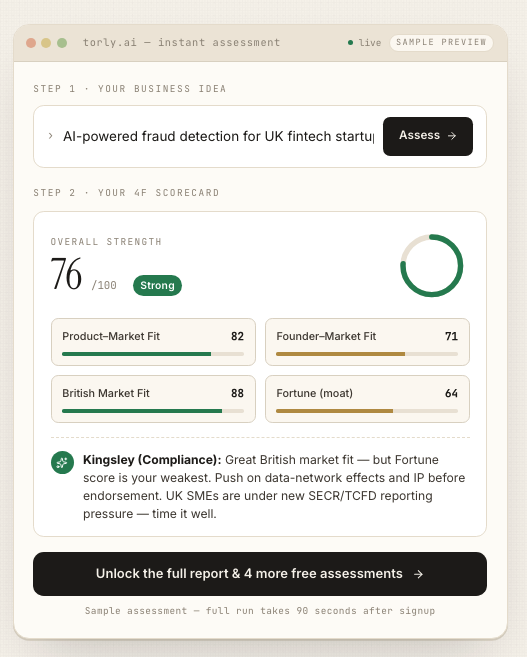
Using a sophisticated UK Innovator Success Predictor allows you to identify critical blind spots in your business model in minutes rather than months, giving you an objective readiness score before you pitch to an endorsement panel.
Pricing Value and Habit: The UTAUT2 Advantage for Consumer Platforms
If your startup targets consumers rather than enterprises, the extended UTAUT2 model introduces three additional adoption triggers you must prove: Price Value, Hedonic Motivation, and Habit.
1. Price Value
In the UK, consumers are value-conscious. You cannot simply assert that customers will pay a monthly subscription. You must demonstrate that the perceived utility of your application substantially exceeds the subscription price. Quantify this trade-off directly in your commercial section.
2. Hedonic Motivation
Does the user enjoy using your software? While novelty attracts initial sign-ups, engaging experiences reduce churn. If your app provides intrinsic satisfaction, highlight this in your retention metrics.
3. Habit and Automaticity
Long-term commercial scalability depends on habit. How does your platform become part of the customer’s daily or weekly routine? Show the endorsing body how notifications, workflows, or integrations convert intentional first-time use into habitual behaviour.
To turn these behavioural principles into an endorsement-ready proposal, you can Build your Business Plan NOW using dedicated AI agents that map directly to endorsing body standards.
Key Mistakes to Avoid in Your Market Fit Narrative
Even brilliant founders fall into common traps when presenting market validation to UK panels. Keep these warnings in mind:
- Relying on Top-Down Market Sizing: Stating that the UK software market is worth £40 billion tells the panel nothing about your business. Use bottom-up validation: show unit economics, local target cohorts, and customer acquisition costs.
- Ignoring UK GDPR and Regulatory Compliance: Endorsing bodies will reject business plans that treat data compliance as an afterthought. Detail your data handling, hosting choices, and privacy controls explicitly.
- Overestimating Willingness to Switch: British enterprises are often risk-averse when switching critical software. Clearly explain your migration tools and onboarding support to counter this friction.
- Failing to Show Active Traction: Letters of intent (LOIs), user interviews, pilot studies, and pre-orders are the lifeblood of viability. Back up your assertions with real-world British market feedback.
Final Checklist: Is Your Business Endorsement-Ready?
Before submitting your application to Envestors, Innovator International, UK Endorsement Services, or any approved body, run through this practical checklist:
- [ ] Have you clearly defined how your product solves a distinct, quantifiable problem in the UK market?
- [ ] Can you prove low effort expectancy through intuitive design or clear onboarding frameworks?
- [ ] Do your financial projections balance realistic growth with the aggressive scalability required by the Home Office?
- [ ] Does your founder profile demonstrate the exact skills necessary to bring this specific technology to commercial fruition?
- [ ] Have you tested your complete submission through an automated evaluation platform to identify compliance gaps?
Taking a scientific approach to customer adoption makes all the difference. When you prove that your startup aligns with validated technology acceptance principles, you demonstrate genuine commercial viability.
Equip your venture with the strategic intelligence it needs to win endorsement. Explore how the UK Innovator Success Predictor can analyse your application, strengthen your business model, and guide you down the fastest path to visa approval.