R and D Strategy and Planning · September 15, 2026
AI-Powered UK Innovator Visa Application Assistant: Smarter R&D Strategy and Planning for UK Founders
Streamline your innovation planning and R&D risk assessment with the AI-Powered UK Innovator Visa Application Assistant for a fraction of traditional advisory costs.


The Brutal Reality of Nailing an R&D Strategy for the UK Innovator Founder Visa
Securing an endorsement for the UK Innovator Founder Visa is no walk in the park. The Home Office and endorsing bodies do not just want to see another generic software dashboard or a standard reselling concept. They demand genuine innovation, viable business mechanics, and clear scalability. Most importantly, they expect a realistic, well-governed technical roadmap. If you cannot prove how your venture pushes technical boundaries, your application hits a brick wall. Building an airtight R&D strategy UK visa pathway means treating your innovation like an enterprise asset from day one, not an afterthought slapped onto an executive summary.
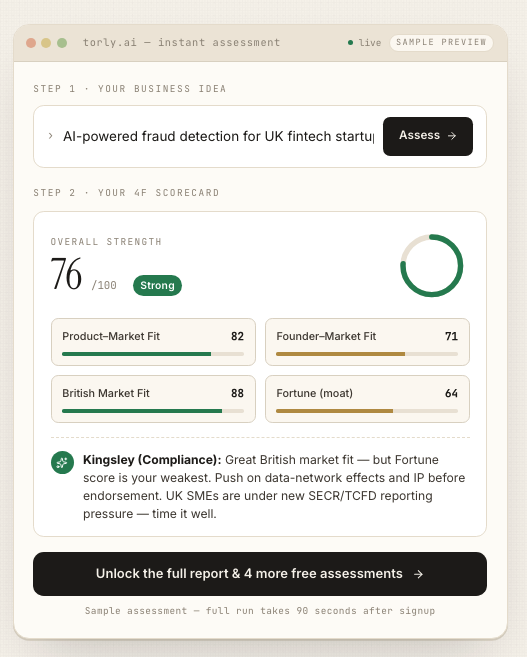
Traditional consultancy firms charge eye-watering fees to review your innovation pipelines and governance frameworks. For an early-stage founder, parting with tens of thousands of pounds before you even land in Britain is simply impractical. That is why modern founders are ditching legacy consulting bloat in favour of modern evaluation tools. You can run an instant AI-Powered UK Innovator Visa Application Assistant check to evaluate your commercial strengths, spot technical blind spots, and streamline your entire compliance submission without the traditional advisory price tag.
Why Endorsing Bodies Care So Deeply About Your R&D Roadmap
What separates a genuine UK startup from an ordinary business? The answer lies inside your research and development plan. Endorsing bodies must verify that you are leading a venture that brings something fresh to the British economy.
When assessors review your proposal, they evaluate three core pillars:
- Innovation: Is your product or service truly original? Are you creating novel intellectual property, or are you just repackaging existing off-the-shelf software?
- Viability: Do you possess the technical chops, market insight, and resource planning to deliver this?
- Scalability: Is there evidence of structured planning, employment growth potential, and international expansion?
Your research strategy links all three criteria together. If your concept relies on machine learning, assessor teams want to know your data collection strategy, your compute budget, and your mitigation tactics for model drift. If you are developing physical hardware, they want to see prototyping milestones, lab partnerships, and component sourcing routes.
A vague sentence stating that you will “hire developers to build proprietary algorithms” will trigger an immediate rejection. You must show the exact methodology, the technical milestones, and the risk matrix that guides your operational spend.
Big Advisory Firms vs AI Agents: The R&D Planning Showdown
For decades, big management consultancies like KPMG have dominated the innovation advisory space. They offer thorough frameworks covering baseline assessments, international standard gap analysis, governance design, and tax credit alignment. Their work is respected and comprehensive.
Yet, there is a fundamental mismatch when early-stage founders approach legacy advisory giants.
The Problem With Traditional Innovation Consulting
- Astronomical Costs: Big corporate consultancies design their services for established enterprises with deep pockets. Early-stage entrepreneurs rarely have spare cash reserves to burn on months of advisory meetings.
- Glacial Timelines: Traditional innovation baseline reviews and horizon-scanning audits often take weeks or months. When visa deadlines or endorsement review windows are looming, you need rapid iterations.
- Immigration Disconnect: While enterprise consultants understand general R&D tax incentives and portfolio management, they rarely understand the micro-nuances of endorsing body criteria. A corporate innovation plan does not automatically tick the specific boxes mandated by Home Office guidelines.
The Modern Way: Intelligent AI Systems
Instead of waiting weeks for manual reports, founders can now rely on platforms like Torly.ai. By using dedicated reasoning agents, you can map your technical capabilities against actual visa benchmarks in real time.
If you want to construct your paperwork step by step, you can use the TorlyAI BP Builder APP to draft comprehensive, endorsement-ready project plans backed by specialised multi-agent reasoning.
How to Structure Your R&D Strategy for Maximum Visa Compliance
To satisfy an endorsing body, your business plan needs a dedicated R&D section that reads like an operational blueprint. Here is how you should assemble it.
1. Establish Your Technical Baseline
Start with a clear breakdown of where your product currently stands. Assessors need to see honesty here.
- What exists today? (e.g., clickable prototype, functional alpha, basic codebase)
- What technical barriers currently prevent commercial launch?
- What specific scientific or technical uncertainties are you attempting to solve?
Documenting real technical hurdles proves authenticity. In the eyes of UK technical assessors, if your project has no uncertainties, it is not genuine research and development; it is just routine implementation.
2. Map Horizons and Market Gaps
Endorsing bodies want proof that your product addresses an unmet commercial need. Combine your technical architecture with external market foresight:
- Competitive Analysis: Detail current market alternatives and explain their exact technical shortcomings.
- Horizon Scanning: Show how emerging regulatory changes, consumer habits, or technical shifts make your solution timely.
- Defensibility: Explain how your planned developments create strong intellectual property barriers against copycats.
When you run a rigorous UK Innovator Gap Analysis, you can pinpoint exactly where your current proposal lacks depth before an endorsing body panel spots the weakness.
3. Resource Allocation and Realistic Budgeting
Your financial forecasts must match your engineering goals. If your plan claims you will build a complex neural network system in four months with a budget of £5,000, your application will lose credibility immediately.
Make sure your financial schedules detail:
- Contractor and in-house engineering salaries based on realistic UK market rates.
- Hosting, cloud infrastructure, and third-party API costs.
- Specialised hardware, lab access, testing environments, or certification fees.
- A sensible contingency buffer (usually 15% to 25%) to absorb unexpected development delays.
If you need a streamlined workflow to organise these technical milestones, you can Build your Business Plan NOW using intelligent prompts that balance your cash flow against project deliverables.
De-Risking R&D for the Innovator Founder Visa
Endorsement panels review hundreds of submissions. They are naturally sceptical about grand claims. You must show that you understand risk governance just as well as you understand coding or product design.
Innovation Accounting and Milestones
Adopt enterprise-grade innovation accounting methods. Break your multi-year technical roadmap down into verifiable quarterly check-ins:
- Proof of Concept (PoC): Testing key assumptions under controlled conditions.
- Minimum Viable Product (MVP): Deploying core functionality to an early beta cohort.
- Validation Stage: Capturing quantitative usage feedback, latency metrics, or customer engagement patterns.
- Commercial Scale: Optimising the architecture for security, data privacy regulations, and multi-region resilience.
This structured breakdown gives endorsing bodies confidence that you are not simply burning capital, but executing a measured, risk-managed commercial programme.
Integrating UK Incentives and Grants
The United Kingdom boasts an attractive environment for technical ventures. Your plan should acknowledge these opportunities to demonstrate long-term commercial savvy:
- R&D Tax Relief: Show awareness of how qualifying R&D expenditure can generate tax credits or cash refunds to support ongoing operations.
- Innovate UK Grants: Demonstrate how specific milestones in your roadmap align with public competition calls and non-dilutive grant programmes.
- Patent Box: If your research leads to registerable patents, outline how your company intends to leverage the UK Patent Box regime to reduce future corporation tax on commercialised intellectual property.
Showing this breadth of financial literacy sets you apart from novice founders who only rely on personal savings or speculative angel cheques.
The Torly.ai Edge: Continuous Intelligence for Founders
Navigating this terrain alone often leads to avoidable errors. Missing a single evidentiary requirement can set your timeline back by months.
Torly.ai replaces guesswork with rigorous evaluation. The platform conducts deep checks across three vital areas:
- Business Idea Qualification: Rigorously testing your concept against Home Office and endorsing body benchmarks for innovation, viability, and scalability.
- Applicant Background Assessment: Measuring your individual domain experience and leadership track record to ensure your profile aligns with your venture.
- Gap Identification and Action Roadmaps: Delivering concrete recommendations to sharpen your business model, strengthen your technical stack, and remove inconsistencies across your narrative.
Operating around the clock, these reasoning agents act as a dedicated review board. They spot logical flaws, verify your market assumptions, and ensure your operational roadmap satisfies real-world scrutiny.
Before submitting your documents to an endorsing body, running your materials through an intelligent UK Innovator Gap Analysis gives you the clarity needed to submit with total confidence.
Final Thoughts: Turn Your Technical Vision into an Endorsement
A compelling R&D strategy UK visa submission is far more than an academic exercise. It is the engine room of your entire application. It proves to assessors that you are not simply asking for permission to live in the UK, but that you are actively building a defensible, forward-thinking business that benefits the wider ecosystem.
Skip the bloated consulting invoices and lengthy advisory cycles. Embrace precision, test your operational assumptions early, and build an application backed by structured data and strategic depth.
Ready to test your readiness and fine-tune your submission? Get started with an AI-Powered UK Innovator Visa Application Assistant today and build a bulletproof roadmap for your UK venture.