Country Specific Startup Visa Guides · September 27, 2026
Beyond European Startup Visas: Meeting British Standards with AI-Powered UK Innovator Visa Application Assistant
Compare European startup schemes against UK endorsing body criteria and learn how AI-Powered UK Innovator Visa Application Assistant helps you prepare an endorsement-ready application package.


The Startup Visa Dilemma: Continental Ease vs British Prestige
Choosing the right ecosystem to launch your venture can make or break your international expansion. Continental Europe has rolled out several appealing schemes in recent years. Programmes like the Italia Startup Visa (ISV) offer clear guidelines: show €50,000 in capital, present an innovative business plan, secure a Nulla Osta through a centralised digital portal, and you are basically good to go. It feels straightforward. Yet many ambitious founders quickly realise that standard European programmes, while accessible, do not offer the sheer scale, private venture capital density, and global prestige of London and the wider UK tech corridor.
The trade-off comes with a harsh reality check. Britain does not simply hand out visas for having money in a bank account. Securing a UK Innovator Founder Visa demands rigorous proof that your venture is genuinely innovative, viable, and scalable according to strict Home Office and endorsing body benchmarks. Navigating these diverging frameworks requires sharp, objective analysis. That is why leveraging a specialised Startup Visa Guidance AI provides international entrepreneurs with the tactical clarity needed to evaluate both routes and construct an endorsement-ready UK business proposition.
Continental Simplicity: The Appeal and Limits of EU Startup Schemes
European startup programmes are generally built to kickstart regional economies. Look at Italy’s framework as a classic example. Administered by the Ministry of Enterprises and Made in Italy (MIMIT), the Italia Startup Visa focuses heavily on formal statutory compliance.
The baseline Italian criteria are well defined:
- Proof of at least €50,000 in financial resources (either personal funds or committed venture backing).
- A formal business model qualifying as an “innovative startup” under Italian legislative decree 179/2012.
- Direct online submission to a centralised technical committee or partnership with a certified Italian startup incubator.
- Receipt of the digital Certificate of No Impediment (Nulla Osta), enabling a local consulate visa issue.
It sounds painless on paper. If you have the funds and tick the boxes, the barrier to entry is manageable. Certified incubators can even handle much of the heavy lifting by issuing formal cover letters.
So, what is the catch?
Scale and capital liquidity. While Italy, Spain, and Portugal offer fantastic living standards and emerging tech hubs, their late-stage investment ecosystems remain comparatively fragmented. Founders often find themselves capped by smaller domestic markets, bureaucratic compliance burdens, and slower rounds of institutional funding. For founders dreaming of a global tech brand, the UK remains the primary gateway to European and transatlantic expansion.
The British Reality Check: Understanding Endorsing Body Expectations
Moving across the Channel changes the game entirely. The UK Innovator Founder Visa does away with the old £50,000 investment funds requirement, but do not mistake that for leniency. Instead of checking your bank balance, British authorities handed evaluation power over to designated independent endorsing bodies.
These bodies do not care about generic business ideas. They judge your application against three strict criteria:
- Innovation: You cannot simply launch a standard consultancy, an ordinary e-commerce shop, or a local service business. Your offering must be original, introducing a genuine technological advantage or market disruption.
- Viability: Does the founder possess the technical skills, commercial acumen, and operational roadmap to deliver? Your market research, cash-flow forecasts, and operational milestones must survive expert financial scrutiny.
- Scalability: The venture must demonstrate clear potential for significant job creation and expansion into international markets, proving measurable economic contribution to the UK.
Failing any single pillar results in an immediate rejection. Unlike European processes where an incubator cover letter can often smooth over rough business plans, UK endorsing bodies examine every page of your financial model, competitor analysis, and IP strategy.
Preparing documentation manually takes hundreds of hours, leaving founders vulnerable to subtle regulatory gaps. Setting up your proposal with the dedicated TorlyAI Desktop APP helps mitigate these pitfalls by structuring your market validation and financial models directly against official endorsing frameworks.
Bridging the Gap: How Founders Shift from EU Schemes to UK Endorsement
Transitioning an idea shaped for a European startup visa into a proposal fit for a UK endorsing body requires a complete change in perspective.
Consider an entrepreneur who drafted a logistics tracking platform for Southern Europe. Under a Mediterranean scheme, highlighting local warehouse partnerships and €50,000 in seed money might pass committee review. But submit that exact business plan to a British endorsing body, and you will be turned down within days. Why? Because basic logistics tracking is already saturated in the UK.
To satisfy British evaluators, that same founder must articulate proprietary IP, automated algorithmic routing, distinct customer acquisition advantages, and multi-year employment targets for local UK workers.
To bridge this divide successfully, founders must:
- Deconstruct local ideas into high-margin, scalable software or deep-tech propositions.
- Demonstrate defensive moats (such as proprietary algorithms, data advantages, or patentable processes).
- Provide stress-tested financial projections backed by verifiable UK market research.
- Prove active founder involvement, demonstrating leadership without leaning on external passive sponsors.
Evaluating whether your operational profile matches these elevated demands is much simpler when you use a reliable AI-Powered UK Innovator Visa Application Assistant to run predictive assessments before submitting your file to an endorsing organisation.
Inside Torly.ai: Advanced AI Agents Built for Visa Readiness
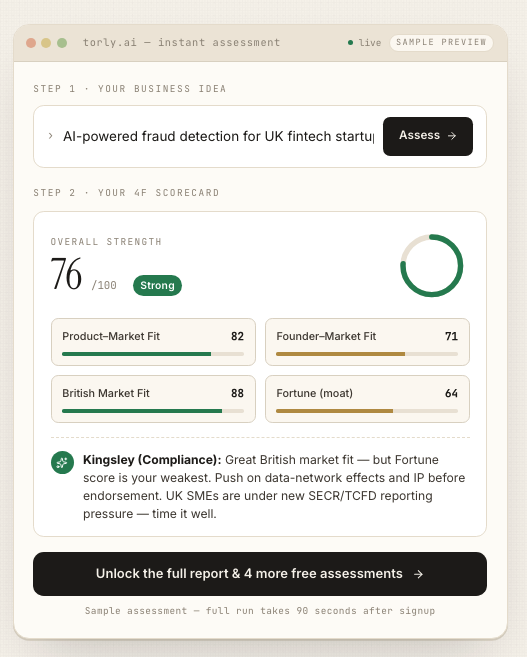
This is where next-generation legal tech shifts the odds in your favour. Torly.ai is designed specifically to solve the uncertainty of the UK Innovator Founder Visa route. It does not just spit out generic templates; it acts as an intelligent visa readiness analyst, evaluating your profile and business idea against actual endorsing body criteria.
Torly.ai runs multi-layered assessments across three fundamental layers:
- Business Idea Qualification: The system audits your core concept, stress-testing whether it satisfies the Home Office definitions of innovation, viability, and scalability.
- Applicant Background Assessment: It analyses your professional history, technical expertise, and commercial background to ensure your profile aligns with founder suitability expectations.
- Gap Identification and Action Roadmap: Instead of simple pass-fail metrics, Torly.ai highlights structural weaknesses in your market positioning, technology stack, and hiring plan, providing clear, actionable steps to rectify them.
Operating 24/7 with continuous reasoning loops, the platform updates its evaluation matrices as endorsement trends evolve. You can actively Build your Business Plan NOW to eliminate guesswork, ensuring your narrative flows seamlessly from technical feasibility to realistic five-year balance sheets.
Comparative Breakdown: Italy Startup Visa vs UK Innovator Founder Visa
To help you visualise how these two pathways diverge, let us look at their structural differences side by side:
| Evaluation Metric | Italia Startup Visa (ISV) | UK Innovator Founder Visa |
|---|---|---|
| Minimum Capital Required | €50,000 demonstrated funds | No statutory minimum (must show viability) |
| Evaluation Authority | Centralised Government Committee (MIMIT) | Independent Approved Endorsing Bodies |
| Innovation Standard | Meets Italian statutory startup criteria | Genuine market disruption and original IP |
| Scalability Requirement | Modest regional growth acceptable | Clear national and international growth plan |
| Incubator Role | Optional fast-track acceptance vehicle | Limited; endorsements handled by select bodies |
| Path to Permanent Status | EU Long-Term Residence (typically 5 years) | Indefinite Leave to Remain (ILR in 3 years) |
| Preparation Strategy | Procedural compliance and bank letters | In-depth commercial and technical vetting |
The table highlights the core difference: Italy offers an accessible starting point with clear financial guardrails, whereas the UK demands deep commercial justification in exchange for rapid settlement (settlement eligibility within three years) and access to Europe’s largest capital market.
If you are transitioning between these markets, working through your strategy with the TorlyAI BP Builder APP ensures that every element of your business plan stands up to the intense scrutiny of British evaluators.
Step-by-Step: Turning European Ambition into an Endorsement-Ready File
Transforming your business concept into a fully endorsed British application requires a systematic approach. Skipping steps or underestimating the depth of documentation will stall your momentum.
1. The Innovation Audit
Begin by asking hard questions about your product. If an existing UK company already provides your exact service, what makes your approach radically better? Endorsement assessors look for proprietary technology, unique distribution methods, or novel business models. Document your IP, system architectures, and market differentiators clearly.
2. Rigorous Market and Competitor Sizing
Broad market figures copied from generic industry reports will not convince endorsing bodies. You need focused, UK-specific data. Who are your direct competitors in Britain? What is your customer acquisition cost (CAC)? What is your realistic lifetime value (LTV)? Ground your financial assumptions in verifiable benchmarks.
3. Assembling the Financial Mechanics
Build a detailed financial model covering at least three years, though five years is increasingly preferred. Your cash-flow statements, balance sheets, and profit-and-loss projections must demonstrate logical consistency. If your plan projects rapid hiring, your revenue lines or working capital must clearly sustain those wages.
4. Founder-Venture Alignment
The endorsing body evaluates you just as much as the business. Highlight your prior entrepreneurial experience, patents, software development background, or sector-specific leadership. Clearly articulate why you are uniquely qualified to lead this venture to commercial viability.
Securing Your Pathway to UK Market Leadership
Relocating your startup to the UK is an exceptional strategic move. While continental routes like the Italia Startup Visa provide welcoming environments for early validation, London and the wider UK market offer the capital depth, legal infrastructure, and international connectivity required to build an enduring global enterprise.
However, success depends on meeting British expectations without shortcuts. Relying on outdated templates or superficial overviews will lead to rejection from discerning endorsing bodies. By taking an analytical, structured approach and using an advanced Startup Visa Guidance AI, you can pinpoint vulnerabilities in your proposal, refine your innovation narrative, and submit an endorsement application built for approval. Ensure your documentation is thorough, validate your assumptions with reliable data, and step into the UK tech landscape with confidence.