Technology Readiness Level Evaluation · September 21, 2026
Beyond TRL: How Torly.ai Measures Your Innovator Founder Readiness Score with the 4F Matrix
Learn how Torly.ai benchmarks your technology and commercial maturity using the 4F Framework to deliver an accurate Innovator Founder Readiness Score.

Why Most Tech Founders Flunk Their Visa Endorsement
You spent eighteen months in the lab. Your code is clean, your models are trained, and your backend handles concurrent queries without breaking a sweat. You think you are ready to conquer the British startup landscape. Then you submit your application to an endorsing body for the UK Innovator Founder Visa, and the response comes back cold: rejected. How does a team with a working product fall flat? Simple. You treated an immigration and venture assessment like a pure engineering review.
Endorsing bodies do not run academic computer science departments. They do not hand out endorsements just because your software runs without errors. They look for commercial viability, market validation, and founder capability. If you rely solely on classic engineering milestones, you miss the bigger picture. That is why calculating a true Innovator Founder Readiness Score before you apply is critical: it shifts your perspective from raw code to commercial execution, pinpointing your blind spots before an official assessor does.
The Flaw of Relying Only on Technology Readiness Levels
NASA invented Technology Readiness Levels (TRL) back in the 1970s. It was brilliant for rocketry. TRL 1 means basic principles observed; TRL 9 means your system is flight-proven in operational space missions.
Startups worldwide borrowed this nine-point scale. If your prototype works in a lab, you say you are at TRL 4. If you have an MVP in a live sandbox, you claim TRL 7. But here is the catch: software does not exist in a vacuum. A product can be at TRL 8 and still fail completely as a business.
Government bodies across the globe know this limitation. For example, India’s NITI Aayog developed the Techno-Commercial Readiness and Market Maturity (TCRM) Matrix Framework. They realised that TRL alone cannot predict commercial success. Their framework blends TRL with Commercialisation Readiness Levels (CRL) and Market Readiness Levels (MRL). They proved that if you ignore customer traction, supply chains, and market demand, your technical progress means very little.
The UK Home Office demands proof of three core criteria:
* Innovation: Is your product genuinely original, bringing something new to the UK market?
* Viability: Does the business model hold up, and do you possess the skills to deliver it?
* Scalability: Can your venture create UK jobs and expand internationally?
A high TRL proves technical capability, but it says almost nothing about viability or scalability. That is why relying purely on technical milestones leaves tech founders completely unprepared for endorsement panels.
Introducing the 4F Matrix: A Multidimensional Audit
To fill the gap between lab experiments and commercial success, Torly.ai developed the 4F Matrix. It looks past surface-level prototypes and conducts a multi-layered assessment of your venture.
The 4F Matrix breaks your startup down into four interconnected pillars:
1. Founder: Your track record, domain expertise, and operational capability.
2. Foundation: The core intellectual property, technical architecture, and problem-solution fit.
3. Feasibility: Commercial unit economics, financial runway, pricing strategies, and legal compliance.
4. Forward Scale: Market size, distribution channels, UK job creation plans, and global expansion strategy.
Instead of presenting an endorsing body with a messy collection of claims, you evaluate how each pillar reinforces the others. If you want to put your narrative together without endless guesswork, you can use the TorlyAI BP Builder APP to structure your market strategy directly alongside your technical milestones.
Here is how the traditional engineering mindset compares to the multidimensional evaluation required by endorsing bodies:
| Assessment Dimension | Traditional TRL Focus | Torly.ai 4F Matrix Focus |
|---|---|---|
| Primary Metric | Technical milestone completion | Balanced readiness across 4 pillars |
| Founder Role | Systems builder / Developer | Commercial leader with operational grit |
| Market Validation | Simulated test environment | Customer discovery, letters of intent, sales |
| Visa Alignment | Barely addresses Home Office criteria | Directly targets Innovation, Viability, Scalability |
| Failure Detection | Catches algorithmic bugs | Uncovers commercial, operational, and regulatory gaps |
Deconstructing the 4F Matrix Pillars
Let us look beneath the bonnet of each pillar to see what endorsing bodies actually inspect.
1. Founder (The Driving Force)
An endorsing body does not invest in an idea; they endorse the person steering it. If an algorithm is brilliant but the founder cannot explain their customer acquisition channel, the application fails. The Founder pillar measures your technical background, leadership history, and resilience. Have you led technical teams? Do you understand the UK regulatory market? If there are gaps in your profile, you need an actionable roadmap to fix them before filing your submission.
2. Foundation (The Innovation Engine)
This is where your technology lives, but with a commercial twist. We do not just ask whether the code runs. We ask: What makes this proprietary? Why can’t a well-funded UK competitor copy your system within six weeks? The Foundation pillar reviews your intellectual property protection, technical defensibility, and your core value proposition.
Before spending thousands on legal consultations, finding out where your project stands using an objective Innovator Founder Readiness Score gives you an unvarnished look at your chances through an automated audit.
3. Feasibility (The Commercial Engine)
Can this business survive? Feasibility scrutinises your cash flow forecasts, cost of customer acquisition, lifetime value, and supply contracts. A business plan filled with arbitrary, sky-high growth projections will get picked apart during the endorsement interview. Assessors want sensible unit economics, realistic hiring plans, and clear evidence that your pricing model covers operational costs.
4. Forward Scale (The UK Economic Impact)
The UK Home Office created the Innovator Founder route to fuel the domestic economy. Forward Scale measures your ability to hire local talent, build partnerships with UK industry leaders, and scale beyond regional borders. If your business model hits a ceiling after hiring two contractors, it is not scalable in the eyes of an endorsing officer.
To assemble the heavy documentation required across all four pillars, founders often turn to dedicated software; you can Build your Business Plan NOW using intelligent prompts that map directly to the expectations of official reviewers.
How Torly.ai Computes Your Score
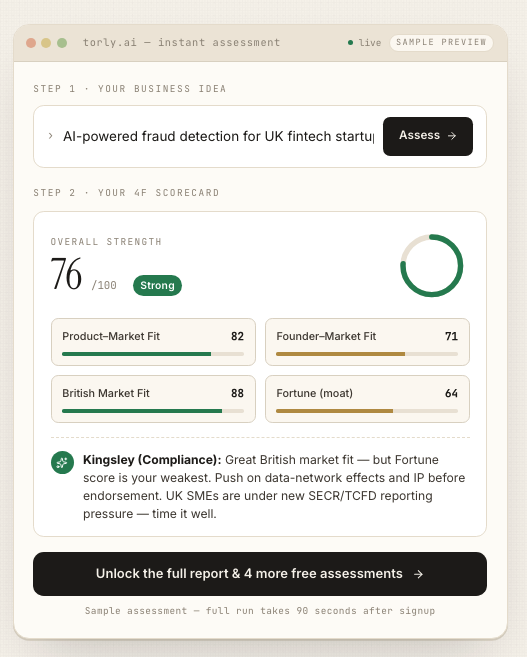
Torly.ai does not hand out a generic percentage based on a superficial questionnaire. Powered by advanced AI reasoning models, the platform runs deep diagnostic sweeps across your business documents, founder profile, and market models.
Here is the exact step-by-step diagnostic journey:
- Step 1: Ingestion and Parsing. You upload your pitch decks, code documentation, technical white papers, and financial forecasts.
- Step 2: Tri-Dimensional Benchmarking. The reasoning engine evaluates your venture across business idea qualification, applicant background suitability, and endorsing body alignment.
- Step 3: Algorithmic Stress Testing. The system checks your projections against historical market benchmarks and past application outcomes.
- Step 4: Gap Identification. The AI isolates weak points, such as an unvalidated customer acquisition cost or a missing UK competitor analysis.
- Step 5: Score Output and Action Roadmap. You receive an aggregated score alongside prioritised steps to turn red flags into strengths.
The output gives you a quantitative score alongside concrete action items. Instead of wondering what an assessor might dislike, you see precisely which operational areas need work.
Common Mistakes Founders Make with Visa Readiness
Founders regularly stumble over the same hurdles. Being aware of these pitfalls can save you months of wasted effort:
- Mistake 1: Treating the endorsement like an academic grant. Evaluators do not hand out marks for intellectual complexity. They want to see cash flow viability, sales funnels, and defensible margins.
- Mistake 2: Copy-pasting generic market research. Quoting broad international market sizes without analysing specific UK segments shows laziness. Assessors spot generic reports instantly.
- Mistake 3: Over-relying on high-level TRL claims. Announcing you have reached TRL 7 does not compensate for an unverified route to market or a complete absence of customer validation.
- Mistake 4: Ignoring team composition and founder suitability. If your product relies on enterprise sales but your background is exclusively academic, your business plan must show how you will bridge that operational deficit.
When you draft your materials, you can deploy the TorlyAI BP Builder APP to keep your documentation focused on these critical business realities instead of getting lost in technical jargon.
Action Plan: Moving from Low Readiness to Endorsement-Ready
If your initial readiness evaluation reveals vulnerabilities, do not panic. A low score simply gives you an early warning system. Here is a clear strategy to systematically lift your numbers:
Shore Up the IP and Defensibility
Document your proprietary architecture clearly. If your software uses machine learning, explain your data pipeline, proprietary weights, or bespoke integrations. Make it clear why an off-the-shelf tool cannot replicate your product overnight.
Gather Direct UK Market Evidence
Move beyond theoretical assumptions. Run discovery interviews with potential British buyers. Secure non-binding letters of intent (LOIs), run pilot trials, or partner with domestic testing sandboxes. Tangible market interest instantly bolsters your Feasibility and Forward Scale metrics.
Fine-Tune Your Operational Model
Ensure your financial projections line up with real-world British operational costs. Account for national insurance, workplace pensions, office overheads, and realistic salaries for technical staff. Endorsing bodies appreciate honest budgets far more than fantasy balance sheets showing instant, effortless profitability.
Secure Your UK Startup Ambitions
Launching an innovative business in the UK is one of the most exciting moves an entrepreneur can make. But navigating the endorsing body ecosystem requires commercial discipline, clear self-assessment, and strategic planning. Relying purely on traditional engineering metrics like TRL leaves you blind to what visa assessors actually scrutinise.
By analysing your startup through the balanced lens of the 4F Matrix, you can identify blind spots early, refine your commercial narrative, and enter your endorsement interview with absolute confidence. Take control of your visa pathway today, benchmark your business against official standards, and track your true Innovator Founder Readiness Score to turn your global ambitions into a thriving UK business.