Product Market Fit Strategies · September 10, 2026
Can You Scale Without Product-Market Fit? AI-Powered UK Innovator Visa Application Assistant Explains
Discover why premature scaling risks endorsement rejection and how AI-Powered UK Innovator Visa Application Assistant uses the 4F Framework to validate product-market fit for British endorsing bodies.


The Premature Scaling Trap That Destroys Visa Hopes
Picture this: you have an exciting tech idea, you hire developers, launch paid campaigns across social media, and burn through thousands of pounds chasing user numbers. You apply for a UK Innovator Founder Visa, fully expecting the endorsing body to marvel at your traction. Instead, you get a swift rejection letter. Why? Because you tried to scale before proving anyone genuinely wants what you are selling. Endorsing bodies do not want vanity metrics; they look for clear viability and defensible traction. When you run an early Founder Market Fit Assessment via Torly.ai, you quickly realise that burning cash to disguise a leaky product bucket is the fastest way to get your visa endorsement declined.
The blunt reality of modern entrepreneurship is that growth cannot fix a broken proposition. If people drop off after one week, double the marketing spend simply means doubling your losses twice as fast. For international founders targeting the UK startup ecosystem, this mistake is fatal. British endorsing bodies (EBs) are specifically tasked by the Home Office to filter out businesses that confuse frantic activity with genuine commercial fit. Achieving stability requires stepping back, evaluating your market signals honestly, and testing your core assumptions before you commit your runway to massive expansion.
Why Scaling Without Product-Market Fit Is Startup Suicide
Think of building a company like bouldering on a sheer rock wall. When you are two metres off the ground and find yourself stuck, you have two choices. You can cling on for dear life, exhaust your forearm muscles, and inevitably crash onto the safety mat. Or you can drop down, shake out the lactic acid, look at the route markers, and plan a better sequence of holds.
Too many startup founders choose the first option. They push harder into advertising, recruit sales reps, and scream about exponential expansion. But scaling without product-market fit (PMF) is like pouring water into a cracked bucket.
Here is what happens when you pour fuel on an unvalidated engine:
- Your customer acquisition cost (CAC) creeps higher every single week.
- Churn rates wipe out top-line revenue gains.
- Team morale plummets because customer complaints overwhelm customer support.
- Your cash runway evaporates, leaving you with zero leverage for future fundraising.
For UK Innovator Founder Visa applicants, the consequences are even steeper. Endorsing bodies scrutinise your business plan to check whether your model is viable and scalable. If your financial projections rely on massive marketing budgets to compensate for low organic retention, assessors will mark your business down as fundamentally non-viable.
To avoid costly missteps in your proposal, you can Build your Business Plan NOW using dedicated tools that stress-test your numbers before officials see them.
The Myth: You Must Freeze Everything Until You Find PMF
Does this mean you should completely halt user acquisition until your product is immaculate? Absolutely not.
A common myth suggests that product-market fit is a binary switch: you either have zero fit or total fit. In reality, early growth experiments are the very laboratory where you discover what works. You do not run marketing campaigns in the early days to generate huge revenue; you run them to purchase data.
To make this practical, treat early growth as pure research across three distinct pillars:
1. Testing the Product Solution
When founders build complex platforms, they often pack them with features nobody asked for. If you launch a three-tiered SaaS platform and user engagement is flat, do not market harder. Split your solution. Run simple pre-orders, interactive wireframes, or feature-specific landing pages to determine which specific tool solves a burning workplace headache.
2. Testing Market Niches
Often, your product is fine, but you are pitching it to the wrong demographic. Consider a health-tech startup offering cognitive tracking. Marketing to “everyone who wants better brain health” is too broad and burns cash. However, isolating specific segments, like corporate executives dealing with burnout versus university students cramming for exams, reveals vastly different conversion behaviours. Narrow down your audience to two distinct cohorts and compare engagement.
3. Testing Language and Value Propositions
Sometimes your product and your market are correct, but your messaging misses the mark. Test plain-text advertisements and simple landing page headlines that highlight raw pain points rather than sleek, generic corporate buzzwords. When your language matches the exact phrase a customer uses when complaining about their problem, engagement metrics change dramatically.
Before committing capital to any of these tests, you can streamline your strategic documentation with the TorlyAI BP Builder APP to map out your hypotheses systematically.
The 4F Framework: How Endorsing Bodies Actually Judge You
British endorsing bodies do not evaluate applications like standard Silicon Valley angel investors who might gamble on wild growth spikes. Instead, they measure your venture against statutory criteria: Innovation, Viability, and Scalability.
To bridge this gap, elite candidates rely on what we call the 4F Framework:
| Framework Pillar | Founder Focus Area | Endorsing Body Expectation |
|---|---|---|
| Founder-Market Fit | Domain expertise, technical authority, relevant track record | Proof that you are the exact right person to lead this venture |
| Feature-Problem Fit | Core functionality addressing an acute commercial pain point | An innovative product that does not duplicate off-the-shelf software |
| Feedback-Iteration Fit | Structured data showing user feedback shaping the roadmap | Documented evidence of customer interviews, pilots, or pre-orders |
| Financial-Unit Fit | Realistic margins, manageable CAC, sustainable lifetime value | Viable unit economics that prove scaling will not bankrupt the business |
Notice what comes first: Founder-Market Fit. Before an assessor looks at your code or your financial model, they look at you. If you have spent ten years in logistics supply chains, launching a logistics optimisation engine makes commercial sense. If you suddenly propose a consumer fashion marketplace without relevant industry connections, your credibility takes an immediate hit.
Getting an objective, automated Founder Market Fit Assessment provides an instant diagnostic on whether your background aligns with your proposed innovation under British migration guidelines.
Diagnosing False Positives: Vanity Metrics vs True Signals
It is surprisingly easy to trick yourself into believing you have found product-market fit. A momentary surge in signups from an influencer post or a cheap ad campaign can feel like triumph. But endorsing bodies look straight through these vanity spikes.
Look at the difference between genuine customer pull and artificial traction:
- The Retention Plateau: In an unvalidated business, user retention heads towards zero over time. In a validated business, the retention curve flattens out. Even if only 20% of users stick around, that stable group proves genuine utility.
- Organic Referral Velocity: Do existing users tell their peers without being bribed by cash discounts? Word of mouth is the purest indicator of product satisfaction.
- Willingness to Pay: A customer who agrees to test your free prototype proves nothing. A business owner who signs an advance letter of intent (LOI) or pays a non-refundable deposit proves viability immediately.
If you struggle to organise these critical validation signals into a coherent visa presentation, you can explore Torly.ai for Innovator Visa Business Planning to align your real-world traction with official Home Office requirements.
How AI Evaluates Your Innovator Founder Visa Readiness
Historically, preparing a business plan for visa endorsement meant hiring expensive legal consultants who often lacked deep tech-sector knowledge, or business coaches who understood startups but had zero grasp of immigration rules.
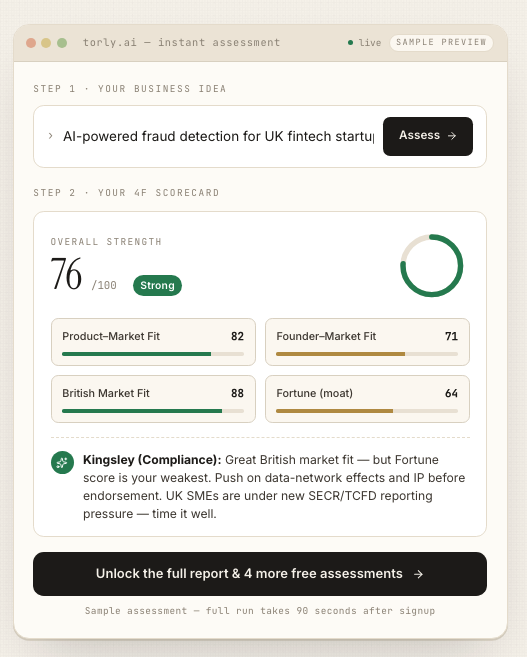
Torly.ai bridges this divide by deploying intelligent AI reasoning agents that evaluate business ideas specifically against UK Home Office standards.
Here is how the automated diagnostic process works:
- Instant Qualification Checks: The platform tests whether your venture meets the statutory definition of an original, innovative idea that cannot be readily copied by domestic competitors.
- Founder Suitability Scoring: It maps your curriculum vitae, employment history, and technical credentials directly against the operational requirements of your startup.
- Commercial Gap Roadmapping: The reasoning engine uncovers structural weaknesses in your financial forecasts, market research, or competitor analysis, giving you actionable steps to patch them before human evaluators review your file.
By testing your proposal against these criteria upfront, you avoid submitting applications that look theoretically attractive but fail practical immigration tests.
Step-by-Step Action Plan to Validate Before You Scale
If you are planning your Innovator Founder Visa application over the next three to six months, do not jump straight into building full-scale production architecture. Follow this step-by-step roadmap to establish genuine product-market validation:
Step 1: Conduct 30 Qualitative Problem Interviews
Speak to individuals in your target sector without pitching your product. Ask them about their daily operational frustrations, how much time those bottlenecks consume, and how much money they currently spend attempting to resolve them. If nobody lists your target problem among their top three workplace priorities, reconsider your angle.
Step 2: Build a Concierge or Prototype Version
Instead of writing complex code, solve the problem manually for three to five clients. Delivering services manually gives you unfiltered insight into customer expectations, edge cases, and unexpected hurdles that automated software would hide.
Step 3: Secure Non-Binding Commitments
Gather documented evidence of demand. For business-to-business models, aim for signed Letters of Intent, pilot trial agreements, or structured feedback logs from recognised UK organisations. For business-to-consumer models, build an organic waitlist with high engagement rates.
Step 4: Run a Complete Strategic Audit
Once you have collected baseline qualitative and quantitative data, consolidate your findings into your business model. You can carry out an exhaustive Founder Market Fit Assessment with Torly.ai to ensure your collected evidence directly supports the viability and scalability metrics required by British endorsing bodies.
Scaling before you have locked down product-market fit is the ultimate startup gamble, and when your right to build your company in the UK hangs in the balance, it is a risk you simply cannot afford to take. Focus on solving a real problem for real users first. The sustainable metrics, the investor interest, and the official endorsement will naturally follow.