Torly.ai · January 6, 2026
UK Innovator Visa AI: Complete Guide to Endorsement Readiness
Evaluate your UK business visa pathways using advanced artificial intelligence. Learn how UK Innovator Visa AI tools assess readiness and guarantee endorsement.

To secure a UK Innovator Founder Visa, an applicant must prove their business idea is genuinely innovative, commercially viable, and scalable, winning endorsement from an official endorsing body. Modern founders now deploy UK Innovator Visa AI tools to evaluate their business plans against strict Home Office rubrics before formal submission, replacing months of blind guesswork with automated data-driven gap analysis. By testing your proposal against predictive endorsement scoring models, you can pinpoint regulatory flaws, refine your market positioning, and streamline your path to British permanent residency in just three years.
Securing entry into the British tech and business ecosystem is notoriously tough. Navigating the changing rules does not have to drain your life savings or involve generic advice from high-street legal teams. Let us explore how intelligent systems analyse startup propositions, dissect the regulatory landscape, and help you systematically construct an airtight case for endorsement.
The Reality of Navigating British Business Visa Pathways
Launching an enterprise in Britain represents a massive ambition for international founders. Between shifting Home Office policies, high legal fees, and cryptic requirements, many qualified innovators walk straight into rejection traps. If you are exploring how UK Innovator Visa AI tools can demystify this process, you are already looking for an unfair advantage in an increasingly competitive landscape. Rather than spending tens of thousands of pounds on traditional consultancies that reuse boilerplate business templates, you can leverage an AI-Powered UK Innovator Visa Application Assistant to calculate your exact readiness score across core immigration criteria in minutes.
Understanding the visa ecosystem means realising that endorsing bodies do not evaluate applicants like traditional venture capitalists. They look for compliance, novelty, long-term British market integration, and verifiable proof that you are the exact founder to build this business. Traditional immigration solicitors understand legal statutes, but they rarely comprehend deep tech, software architectures, or realistic financial unit economics. Combining immigration regulations with intelligent software evaluation bridges this dangerous gap, giving you a crystal-clear path to endorsement before you ever submit a single document.
Understanding the Core UK Business Visa Routes
Before picking a pathway, you must understand how the UK categorises overseas business talent. The Home Office has retired several older categories, such as the legacy Start-up route and the Tier 1 Entrepreneur programme. Today, the system focuses heavily on high-growth, innovative commercial ventures.
The Innovator Founder Visa
This is the premier route for overseas entrepreneurs wanting to establish an innovative business in the UK. The most attractive feature of this route is its fast-track settlement: successful applicants can qualify for Indefinite Leave to Remain (ILR) after just three years, compared to the standard five-year timeline required by most economic routes.
To qualify, your business proposition must meet three statutory criteria assessed by an approved Endorsing Body:
- Innovation: You must have a genuine, original business plan that meets new or existing market needs, creating a distinct competitive advantage over existing UK businesses.
- Viability: You must possess the necessary skills, knowledge, and market awareness to run the business successfully, backed by realistic financial projections.
- Scalability: You must present structured evidence showing significant potential for job creation and growth into national and international markets.
Unlike older visa formats, there is no mandatory £50,000 minimum investment capital requirement, provided you can prove the business has adequate capital to reach its next milestone.
Self-Sponsorship Under the Skilled Worker Route
Some founders bypass the endorsing body process entirely by setting up a UK entity, applying for a Home Office Sponsor Licence, and sponsoring themselves as a Skilled Worker. While viable, this route requires considerable administrative overhead, including director salary thresholds, real-time PAYE reporting, and adherence to strict compliance audits. Furthermore, ILR under this category takes a full five years rather than three.
Expansion Worker Visa (Global Business Mobility)
If you already run an established overseas business and wish to expand into the British market, the UK Expansion Worker visa allows you to send a senior employee or founder to establish a UK footprint. However, this route is strictly temporary: it does not lead directly to settlement and caps your stay at a maximum of two years.
| Visa Route | Minimum Capital Required | Endorsement Needed? | Time to UK Settlement (ILR) | Primary Hurdle |
|---|---|---|---|---|
| Innovator Founder Visa | None (must be viable) | Yes (Approved Body) | 3 Years | Proving high innovation & scalability |
| Self-Sponsorship (Skilled Worker) | Company operating funds | No (Requires Sponsor Licence) | 5 Years | Complex sponsor licence compliance |
| UK Expansion Worker | Company operating funds | No (Requires overseas link) | No direct route | Temporary status; branch only |
How UK Innovator Visa AI Evaluates Your Application
Why are tech founders turning to specialized artificial intelligence platforms rather than relying exclusively on lawyers? The answer lies in how endorsing bodies review your documents.
Endorsing bodies read hundreds of submissions every month. They follow rigid assessment rubrics. If your financial forecast shows basic accounting contradictions, or if your competitor research claims you have zero competitors in London, your application gets discarded quickly. Dedicated UK Innovator Visa AI platforms mirror the exact evaluation criteria used by these bodies, testing your material against hundreds of successful structural benchmarks.
1. Instant Business Idea Qualification
Natural language reasoning models ingest your executive summary, pitch deck, and architecture overview. The AI cross-examines your value proposition against existing UK patent databases, Companies House records, and market intelligence reports. It flags whether your core technology represents a genuinely original innovation or merely an incremental digital tweak that an endorsing body will reject.
2. Comprehensive Founder-Market Alignment
Your CV, employment history, and technical credentials undergo multi-dimensional analysis. An endorsing body wants to know: why are you uniquely qualified to build this enterprise? The system identifies where your professional profile fails to demonstrate technical or operational leadership, pointing out the exact certifications, advisory board additions, or credentials needed to satisfy assessors.
3. Automated Gap Identification
Instead of receiving vague rejection feedback months down the line, automated evaluation highlights precise structural failures across your narrative. Whether you neglected British regulatory certifications (such as FCA rules or GDPR compliance) or failed to explain your customer acquisition pipeline, the model provides direct action steps to repair every flaw.
The Innovatorly Matrix (4F Framework) Explained
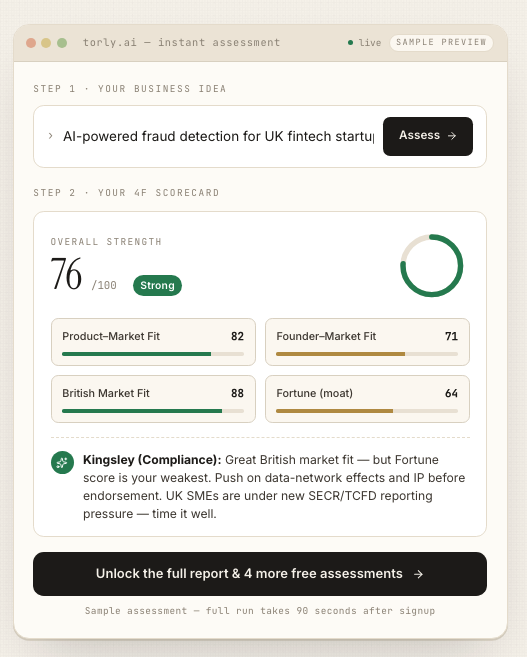
To make your visa readiness tangible, top evaluation systems rely on a structured formula rather than subjective hunches. The most reliable framework available for scoring readiness is the Innovatorly Matrix (4F Framework).
This framework calculates your overall likelihood of securing endorsement through a clear formula:
Endorsement Success = PMF x FMF x BMF + Fortune
Let us break down each dimension and see how it dictates your final outcome.
1F: Product-Market Fit (30% Weight)
Product-Market Fit measures how cleanly your innovation solves an urgent, addressable problem. Endorsing bodies despise solutions looking for a problem. They expect documented proof that a target demographic is actively seeking your software, physical product, or service. In your application, this means demonstrating early customer validation, letters of intent (LOIs), user survey metrics, or pilot agreements.
2F: Founder-Market Fit (25% Weight)
Founder-Market Fit checks whether your personal track record aligns with the business sector. If an applicant with a decade in supply chain logistics suddenly submits a business plan for an AI-based genomic sequencing tool, alarm bells ring. Endorsing assessors want to see domain authority, leadership capabilities, and past execution success. If you lack direct industry tenure, your documentation must clearly highlight technical co-founders or key advisors who balance your skill profile.
3F: British Market Fit (25% Weight)
British Market Fit evaluates why your enterprise needs to exist inside the United Kingdom rather than your home country. Assessors frequently reject proposals that could easily operate elsewhere without touching the UK economy. To score high in this quadrant, you must show clear contributions to British innovation, plans to recruit domestic staff, alignment with regional industrial strategies, and direct benefits to local commercial ecosystems.
4F: Fortune (20% Weight)
Fortune represents strategic timing, endorsing body selection, and macroeconomic readiness. Different endorsing bodies have specific appetites, sectoral preferences, and internal review bandwidth. Matching your business sector to the exact endorsing organisation most receptive to your technological niche removes pure luck from the equation.
If you want to construct your paperwork using this exact formula, you can download the TorlyAI Desktop APP to run automated diagnostics across your entire operational model.
Why Traditional Visa Consultancy Falls Short for Modern Startups
For decades, immigration lawyers held a monopoly over visa preparation. While legal representation remains essential for formal Home Office submissions, classical consultancies reveal clear limitations when building startup dossiers.
High Hourly Rates Without Business Acumen
Immigration solicitors bill hundreds of pounds per hour. Yet, their formal legal education focuses on immigration law, asylum cases, and statutory compliance, not venture scalability, SaaS retention metrics, or API distribution strategies. Paying an immigration paralegal to draft your commercial strategy often results in an unconvincing, generic business plan that tech-literate endorsing bodies see through immediately.
Rigid Turnaround Times
Traditional visa consultancies often take weeks or months to return draft iterations. In the fast-moving tech environment, market dynamics change, new competitors arise, and opportunities close. Modern AI agents process complex data changes in seconds, updating financial sheets, operational timelines, and risk assessments instantly.
The Hybrid Solution
The smartest entrepreneurs adopt a balanced strategy: use deep UK Innovator Visa AI engines to construct, test, validate, and stress-test every business document, then have an immigration solicitor conduct a final legal check before submission. This methodology preserves your capital, speeds up drafting by months, and results in a substantially higher quality submission.
Step-by-Step Guide to Engineering an Endorsement-Ready Dossier
Building an application that secures an endorsing body’s approval requires systematic execution. Here is the operational workflow recommended to maximise your chances.
Step 1: Run an Instant Eligibility Diagnostic
Before writing an 80-page business plan, test your fundamental concept. Use an Instant Eligibility Checker to score your concept against Home Office statutory definitions. This preliminary screen verifies whether your idea possesses adequate novelty or if it risks classification as an ordinary service business.
Step 2: Assemble the 12-Section Strategic Business Plan
Endorsing bodies expect a structured 12-section business plan. Your document must cover:
- Executive Summary: A concise pitch outlining the core innovation and business vision.
- Company Overview & Governance: Corporate structure, share capital distribution, and articles of association.
- The Problem & Market Need: Quantified proof of an existing market gap.
- The Proposed Solution: Your proprietary technology, intellectual property, or innovative operational workflow.
- Target Market & Customer Personas: Clear segmentation of your addressable audience.
- Competitive Advantage Matrix: Evidence showing why established competitors cannot easily duplicate your offer.
- Marketing & Sales Strategy: Concrete customer acquisition costs (CAC) and projected lifetime value (LTV).
- Operational Plan & Milestones: A 36-month timeline charting research, development, hiring, and geographic rollout.
- Management Team & Advisory Board: Credentials proving founder capability and strategic governance.
- Financial Projections & Modeling: 3-year cash flow forecasts, profit and loss statements, and balance sheets.
- UK Economic Impact & Employment: Clear forecasting of full-time resident worker job creation.
- Risk Analysis & Mitigation: Comprehensive SWOT and regulatory risk registers.
To eliminate manual formatting errors and ensure every section aligns with official rubrics, you can utilise an automated Business Plan Generator to build your draft accurately.
Step 3: Construct Defensible Financial Projections
Financial forecasts are where most DIY applicants fail. Unrealistic profit margins or unsupported revenue leaps immediately disqualify a proposal. An automated Financial Modeling Tool helps generate realistic, double-entry projections that reflect standard UK corporation tax rates, National Insurance contributions, and sector-specific operational overheads.
Step 4: Audit Against Regulatory Compliance
Before any human eyes see your application, pass all files through a Compliance Validation Feature. This automated step checks your submission package against the latest Home Office Immigration Rules, eliminating outdated references, inconsistent dates, or missing identity documentation.
Step 5: Organise Evidence Packages
An endorsing submission often contains 40 to 60 supporting documents, including CVs, contracts, letters of support, patents, and financial statements. Managing these through a systematic Document Organization System ensures endorsing assessors can easily navigate and verify your claims.
Step 6: Polish Your Endorsement Interview Presentation
Once your written submission clears initial screening, endorsing bodies typically invite you to a rigorous 30 to 45-minute remote interview. You will face questions designed to test whether you truly wrote the plan or merely paid an agency to write it for you. Preparing an impactful slide deck using a Pitch Deck Creation Tool lets you deliver confident, structured answers regarding your unit economics and growth roadmap.
How AI Agents Handle Complex Endorsement Criteria
Understanding how advanced AI agents inspect your documentation can help you frame your narrative effectively.
Modern agentic software does not rely on a single, generic prompt. Instead, specialised agents run concurrently to inspect different parts of your venture:
- The Market Research Agent: Scours real-time competitor platforms, assessing your pricing tier against active UK competitors to verify market differentiation.
- The Financial Modeling Agent: Tests your sensitivity tables, balance sheets, and unit costs against real UK economic conditions and current wage requirements.
- The Compliance Agent: Audits every claim against Appendix Innovator Founder of the Immigration Rules, ensuring that you do not inadvertently describe your business in a way that violates visa conditions.
This multi-agent architecture ensures that every paragraph of your submission is scrutinized from multiple professional angles prior to formal filing.
Preparing for the Endorsement Body Interview
Many founders assume that once their business plan is submitted, the hard work is over. In reality, the endorsing interview is the decisive filter. Assessors know that business plans can be outsourced; an interactive interview reveals whether the applicant truly understands their venture.
Here are the critical areas you must master for your interview:
1. Detailed Financial Fluency
You must know your numbers off by heart. If an assessor asks about your projected burn rate in Month 14 or your customer acquisition costs across digital channels, you cannot hesitate or fumble through spreadsheets. You must articulate your unit economics cleanly and explain the underlying assumptions behind your working capital requirements.
2. Deep Explanations of UK Market Integration
Assessors will grill you on your competitive landscape. Be prepared to name your top three UK-based competitors, explain their market share, and pinpoint why your product delivers a superior, defensible alternative. Never state that you have no competitors; assessors consider that an immediate red flag demonstrating insufficient market research.
3. Clear Job Creation Milestones
To achieve settlement (ILR) after three years, your business must meet specific growth benchmarks set by the Home Office. These benchmarks include creating at least five full-time jobs for settled workers with an average salary of £25,000, or creating at least ten full-time jobs with no specific salary floor. In your interview, you must clearly map out your hiring plans to show how your operational expansion will hit these statutory targets.
Common Pitfalls That Lead to Visa Refusal
Learning from common submission errors is the easiest way to protect your application. When analyzing failed applications, recurring patterns quickly emerge:
The ‘Lifestyle Business’ Trap
Opening an e-commerce storefront, an import-export consultancy, or a digital marketing agency rarely satisfies innovation standards. If your company relies on off-the-shelf business systems and conventional operational playbooks, endorsing bodies will deem it a standard commercial business rather than an innovative venture, regardless of how profitable it might be.
Lack of Genuine Technical Differentiation
Adding an AI wrapper around an existing third-party API does not automatically make your startup innovative. Assessors want to understand your proprietary IP: are you training custom models, developing bespoke processing pipelines, or engineering unique user experiences that cannot be reproduced overnight?
Ignoring the Two-Year Checkpoint Requirements
Your endorsing body is legally mandated to monitor your progress at regular checkpoints (typically Month 12 and Month 24). If your initial business plan sets unachievable goals, you will struggle to demonstrate sufficient progress during these mandatory reviews, placing your visa extension and settlement in severe jeopardy.
Transitioning to Indefinite Leave to Remain (ILR)
The ultimate goal for most founders embarking on this route is permanent residency in the United Kingdom. The Innovator Founder Visa provides one of the fastest routes to ILR, granting eligible entrepreneurs the right to apply for settlement after just 36 months.
To qualify for settlement, your business must remain active, solvent, and endorsed, meeting at least two of the following Home Office criteria:
- At least £50,000 has been invested into the business and actively spent furthering the business plan.
- The business has generated a minimum of £200,000 in gross revenue in the previous 12 months.
- The business has generated at least £100,000 in gross revenue in the previous 12 months, with at least £50,000 derived from exports.
- The business has created at least 10 full-time jobs for resident workers.
- The business has created at least 5 full-time jobs for resident workers with an average salary of £25,000 per year.
- The customer base has at least doubled within the most recent three-year period and is higher than the mean average customer base for comparable UK competitors.
- The business has engaged in significant research and development activity and has applied for intellectual property protection in the UK.
By building your initial application with structured tools, you can intentionally design your 36-month operational roadmaps to ensure hitting these metrics is realistic, verifiable, and stress-free.
Take Control of Your Endorsement Journey
Attempting to secure a UK Innovator Founder Visa through guesswork and manual document drafting is an unnecessary risk. The bar for entry is high, but the rewards—scaling an innovative enterprise inside one of the world’s most dynamic startup economies and gaining British residency in three years—are exceptional.
Using intelligent software to guide your application removes uncertainty, improves document accuracy, and gives you the exact competitive edge needed to win endorsing body backing. Evaluate your concepts rigorously, structure your financial models cleanly, and present your commercial vision with undeniable clarity.
Ready to transform your innovative business concept into a fully endorsed British enterprise? Take your next step right now and Build your Business Plan NOW with intelligent guidance designed specifically for Innovator Founder Visa success.