AI Surveillance and Immigration Enforcement · September 25, 2026
Ethical AI in Immigration: How AI-Powered UK Innovator Visa Application Assistant Empowers Founders Transparently
Discover how AI-Powered UK Innovator Visa Application Assistant leverages ethical AI reasoning to simplify complex visa requirements and secure endorsement without invasive border surveillance concerns.


The Digital Border Dilemma: Surveillance vs Real Founder Empowerment
Most news about technology at borders sounds like a dystopian film. You hear about automated lie detectors, facial recognition cameras, biometric scanning, and algorithms triaging human beings like luggage. In her research on high-tech border regimes, legal scholar Petra Molnar pointed out that hundreds of millions of pounds get poured into invasive surveillance tools that often fail to deliver on basic fairness. Governments claim these opaque systems build efficiency, yet they routinely create black-box hurdles for genuine applicants. When technology is built purely to police, exclude, and profile, everyone suffers: especially ambitious international entrepreneurs who just want a fair shot at launching a venture.
Thankfully, there is another side to the story. Instead of turning tech into a hostile gatekeeper, ethical systems flip the table. They place computational power straight into your hands. This is the heart of constructive AI Legal Tech Migration, where software does not snoop on you, but actively helps you unpack convoluted rules, validate business viability, and secure endorsement. With the right platform, such as an AI Legal Tech Migration assistant built for UK founders, applicants can navigate Home Office expectations with radical clarity instead of fearing shadowy digital checkpoints.
The Dark Side of Border Tech: Why Opaque Systems Fail Everyone
Let us look at what happens when state-run tech goes unchecked. Across Europe and North America, immigration agencies test automated systems to predict risk. They scrape social media profiles. They deploy micro-expression detectors. Some border programs even experiment with robotic patrol units.
What is the outcome? According to legal experts and field researchers, much of this experimental border tech is little more than digital snake oil. It often reflects historic human biases, misinterprets normal behaviour, and locks innocent applicants out of the conversation.
Consider these core issues:
* The Black Box Problem: You receive a refusal or a delay, but no human can clearly explain why the algorithm flagged you.
* Biased Training Data: Profiling algorithms frequently penalise founders based on nationality, accent, or non-traditional CV layouts.
* Erosion of Due Process: When an automated system quietly scores your credibility behind closed doors, your right to present your story fairly disappears.
When governments deploy technology strictly for border enforcement, the focus is on finding reasons to say no. That creates a climate of anxiety. If you are an entrepreneur planning to launch an enterprise in Britain, you do not need more opaque filters; you need transparent tools that explain the rules of the road.
Turning the Tables: AI as an Advocate, Not an Adversary
What if machine intelligence worked for you instead of against you?
That is the difference between surveillance tech and applicant-facing legal technology. While border enforcement software hoards data to look for infractions, applicant-centric AI gives you clear feedback to help you succeed.
Think of it like preparing for a difficult exam. In the old world, an examiner sat silently in the shadows, waiting for you to fail. In the new model, an intelligent tutor sits beside you, reviewing your working notes, pointing out where your logic is shaky, and helping you build the strongest case possible before you hand in your paper.
When planning your venture, you can test ideas early using tools like the TorlyAI BP Builder APP, ensuring that your proposal meets official standards long before an endorsing officer reads a single word. Ethical legal technology never hides the rubric. It opens the handbook and gives you the tools to meet every benchmark.
Tackling the UK Innovator Founder Visa: The Three Big Hurdles
The UK Innovator Founder Visa is designed to attract forward-thinking minds from across the globe. Yet, thousands of applicants run into a brick wall during the endorsing body stage. Endorsing bodies do not just glance at your bank statements; they evaluate your fundamental business proposition.
To win endorsement, your business plan must tick three non-negotiable boxes:
1. Innovation
You cannot simply open a copycat consultancy or a standard shopfront. You must prove you have a genuine, original business idea that meets a new or existing market need. It must create a competitive advantage. Proving true innovation requires detailed market differentiation, defensible intellectual property strategies, and a deep understanding of the UK market.
2. Viability
Do you have the necessary skills, knowledge, and market awareness to pull this off? Endorsing bodies assess whether your financial forecasts make sense or if they look like wishful thinking. They review your operational plan, your supply chain assumptions, and your unit economics.
3. Scalability
Can this business grow? An endorsing body wants to see evidence of structured planning, clear job creation potential in the UK, and realistic projections for domestic and international expansion.
Meeting all three standards simultaneously is where most independent founders struggle. You might be a brilliant software engineer or an inventive product designer, but writing a 50-page commercial expansion plan tailored to UK regulatory frameworks is an entirely different discipline.
How Torly.ai Restores Balance to the Visa Journey
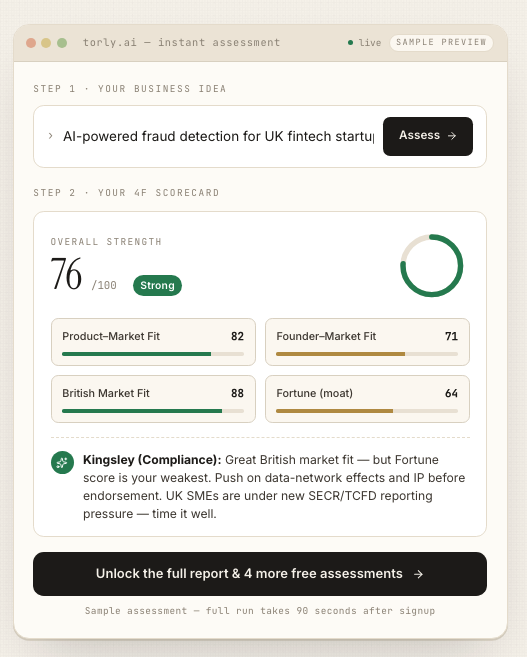
This is where dedicated AI agents change the equation. Torly.ai was designed specifically as an evaluation-driven platform to demystify the Innovator Founder Visa route. It does not replace the human judgment of endorsing bodies; it prepares founders to meet their high expectations transparently.
Instead of acting as a simple text editor, Torly.ai acts as a multi-layered evaluation analyst. It operates across three core dimensions:
* Business Idea Qualification: It assesses whether your concept meets the statutory definitions of innovation, viability, and scalability before you spend thousands of pounds on formal applications.
* Applicant Background Assessment: It evaluates your real-world experience, technical background, and leadership capabilities to see how well they match endorsing body expectations.
* Gap Identification and Action Roadmaps: It does not just say “no.” It pinpoints exactly where your numbers look thin, where your market research lacks citations, or where your operational roadmap needs work.
By putting the applicant in charge of their own readiness evaluation, our ethical AI Legal Tech Migration platform turns what used to be a stressful guessing game into an objective, data-informed preparation process.
The Multi-Agent Advantage: Why Generic Chatbots Fall Short
A lot of people ask: “Can I just write my business plan using a standard chatbot?”
In short: please do not. Generic language models are built to please the user, not to interrogate commercial strategies. If you ask a standard chatbot whether your idea is innovative, it will almost certainly tell you it is fantastic. It will hallucinate market figures, invent optimistic timelines, and produce generic prose that experienced endorsing bodies spot within two minutes.
Torly.ai approaches this problem through specialised agentic architecture. Rather than relying on a single prompt, the system breaks down the visa readiness process into dedicated, rigorous evaluations:
When you work with a specialised setup, each agent evaluates a distinct requirement. One checks your gross margins against standard UK industry benchmarks. Another challenges your market assumptions. A third audits your compliance requirements against current Home Office rules.
If you are ready to construct your formal submission, you can Build your Business Plan NOW using systems trained on actual immigration criteria, rather than generic web text.
Transparent Data Practices: Why Privacy Must Come First
Given the legitimate fears surrounding high-tech border surveillance, ethical legal technology must adhere to strict data boundaries. Migrants and founders regularly worry about who sees their proprietary algorithms, personal financials, and strategic documents.
Responsible legal platforms operate under strict digital hygiene standards:
* Zero Hostile Sharing: Your ideas, intellectual property, and personal records should never be fed into public training sets or shared with external monitoring agencies.
* Transparent Logic: When an assessment highlights a weakness in your financial model, it explains the exact logic behind that score.
* Applicant Control: You decide which drafts to keep, what scenarios to test, and when your materials are ready for human review.
This focus on user privacy directly challenges the surveillance culture highlighted by civil rights advocates. Technology should empower creators to showcase their talents, not treat them as risks to be catalogued.
Concrete Steps to Prepare an Endorsement-Ready Application
If you are getting ready to apply for the UK Innovator Founder Visa, avoid the common traps that lead to rejections. Follow this practical framework:
-
Pressure-Test Your Differentiator Early
Do not wait for an endorsing body panel to tell you that your product is too similar to existing UK companies. Run a comprehensive market scan to identify direct and indirect competitors across the UK and Europe. -
Ground Your Financials in Fact
Endorsing bodies quickly dismiss revenue charts that show vertical hockey-stick growth without sensible staffing and marketing costs. Ensure your salary structures reflect realistic UK wages and that your cost-per-acquisition estimates are rooted in real sector benchmarks. -
Demonstrate Genuine Commitment
The Innovator Founder route requires you to lead and develop the business day-to-day. Your documentation must show that you possess the hands-on expertise to drive the enterprise forward, rather than acting as a passive investor. -
Address Your Weaknesses Before Submission
Every business has blind spots, whether it is an incomplete sales pipeline or a lack of regulatory permissions. Endorsing bodies respect candidates who acknowledge these operational challenges and present clear remediation plans.
To simplify these complex steps, explore how the TorlyAI BP Builder APP helps structure each section systematically, guiding you through market research, cash-flow projections, and endorsement requirements.
Reclaiming Technology for the Global Entrepreneur
The narrative around technology in immigration does not have to be defined by razor-wire fences, facial-recognition scans, and secret algorithms. While border enforcement agencies continue to experiment with expensive surveillance apparatus, founders now have access to equalising tools that level the playing field.
Transparent, evaluation-driven AI dismantles bureaucratic gatekeeping. It translates difficult statutory requirements into clear, manageable tasks, giving international founders the confidence to present their visions clearly and accurately.
You do not need to walk into the visa application process in the dark. By partnering with advanced, ethical preparation tools, you can cut through the noise, strengthen your commercial proposition, and build a venture that thrives in the UK economy. Get started today with the modern AI Legal Tech Migration toolkit, and take control of your journey from early concept to official endorsement.