Startup Hubs and Ecosystems · September 19, 2026
Global Hubs vs London: Scale into the UK with AI-Powered UK Innovator Visa Application Assistant
Explore global startup hub alternatives and see why international founders use AI-Powered UK Innovator Visa Application Assistant to build UK-specific business models that secure visas.


The Global Tug-of-War: Why Savvy Founders Target London Over Rival Megacities
Choosing where to anchor your overseas business can feel like betting on a roulette wheel. Global hubs are throwing huge cash subsidies, deep-tech tax credits, and streamlined residency pathways at high-growth founders. Look at Asia: the Tokyo Metropolitan Government is actively targeting overseas deep-tech and fintech ventures through programmes like the Tokyo Financial Award, green transformation subsidies, and dedicated foreign bank account networks. Tokyo commands a massive one-trillion-dollar regional GDP and an urban base of 14 million people. It is an incredible city, but scaling a business there often means wrestling with local corporate hierarchy, complex bilingual operations, and slower international market integration.
London, by contrast, gives you instant access to English-speaking legal frameworks, deep pools of venture capital, and a direct corridor to European and US enterprise buyers. The hurdle? The UK Home Office does not hand out founder visas just because you have a neat pitch deck. To pass endorsement bodies, your projections must prove genuine innovation, clear market viability, and rapid scalability. Nailing that balance requires a stress-tested Startup Visa Financial Model with our AI-Powered UK Innovator Visa Application Assistant, built specifically to survive the scrutiny of official evaluators. Without a rock-solid model, even brilliant products hit a bureaucratic brick wall before day one.
The Global Ecosystem Map: Comparing Hub Realities
Every major tech capital claims it wants international talent. Yet, beneath the flashy brochures, the day-to-day founder journey varies wildly. Let us compare the landscape.
- Tokyo, Japan: Excellent infrastructure, generous municipal subsidies (such as Tokyo GX and overseas establishment support), and massive local capital. However, language barriers, complex administrative onboarding, and a market tilted heavily towards domestic conglomerates make hyper-scale international software hard to execute.
- Singapore: Super clean corporate governance and low corporate taxes, but the domestic market is tiny. You must expand across diverse Southeast Asian borders immediately to justify high operational costs.
- Berlin, Germany: The creative powerhouse of mainland Europe with strong developer talent, yet bogged down by notorious paper-based bureaucracy and rigid labour regulations.
- London, United Kingdom: The undisputed European capital of tech investment. You get seamless company formation, deep institutional capital, access to world-class universities, and direct regulatory sandboxes for fintech and AI.
The UK market is particularly hungry for applied AI, health-tech, clean-tech, and enterprise software. But the UK Home Office has handed the gateway keys entirely to independent endorsing bodies (EBs). These bodies do not care about vague vanity metrics; they judge you strictly on three statutory criteria: Innovation, Viability, and Scalability.
Why Typical Financial Plans Fall Flat with UK Endorsing Bodies
Most tech founders make a fatal mistake: they take their generic pitch deck spreadsheets, slap on a British pound symbol, and submit it as their business plan. Endorsing bodies see right through this in minutes.
First, an endorsement panel wants to see viability verified by defensible unit economics. If your customer acquisition cost (CAC) is a wild guess, or your customer lifetime value (LTV) ignores UK-specific market realities, your viability score drops.
Second, the scalability requirement mandates that you demonstrate high-quality job creation for settled workers in Britain. You cannot just project revenue growth; you have to balance headcount expansion, national insurance obligations, realistic UK salary bands, and workplace pension costs against cash runway.
To eliminate these blind spots before submitting your dossier, smart founders turn to specialised tools like the TorlyAI Desktop APP to build your business plan now, ensuring every balance sheet row stands up to administrative cross-examination.
Breaking Down the Startup Visa Financial Model: What Evaluators Check
Building a compliant financial projection for immigration purposes is very different from pitching an angel investor over coffee. An angel might love your boundless optimism; an immigration assessor is actively searching for unmitigated risk.
Here is what your model must account for to secure endorsement:
1. Granular Working Capital and Runway
You must show that your initial share capital, whether self-funded or backed by third-party investment, comfortably covers operating costs until the business generates sustained free cash flow. If your runway dips below zero even for a single month in Year 2 projections, the model is rejected.
2. Localised UK Operating Costs
Do not copy Silicon Valley or Asian burn rates into your projections. You need accurate figures for UK office space, registered office representation, insurance, professional legal fees, server costs, and marketing spend tailored to European acquisition channels.
3. Detailed Staffing Matrices
Endorsing bodies will review whether your hiring plan aligns with statutory settlement targets. Your model must document job titles, hire dates, gross wages, and employer national insurance contributions. You must demonstrate that your company creates skilled local employment rather than outsourcing core IP creation abroad.
When you need to turn raw commercial assumptions into an endorsement-ready submission, you can leverage a structured Startup Visa Financial Model to calculate dynamic hiring costs and stress-test your margins under multiple market conditions.
4. Revenue Recognition and Sensitivities
How do you make money? Subscription plans, transactional cut-rates, enterprise licensing? You must spell out your payment cycles, VAT handling, and churn assumptions. Endorsing bodies will expect to see base, upside, and downside scenarios. If your revenue model fails under a modest 15% increase in acquisition costs, it lacks the resilience required for an Innovator Founder endorsement.
The Advantage of AI Evaluation for Visa Readiness
In the past, founders spent thousands of pounds on immigration solicitors who understood the legal paperwork but had zero clue how to assess SaaS metrics, churn cohorts, or deep-tech product development. Alternatively, founders hired startup consultants who could write a decent pitch deck but failed to align it with Home Office immigration appendices.
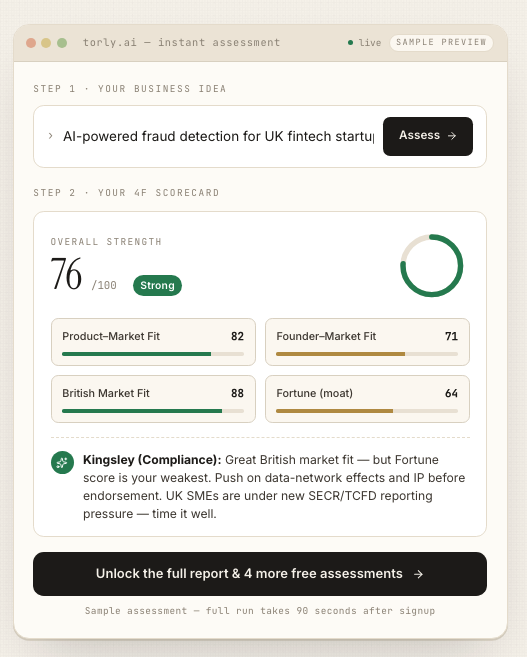
Today, advanced artificial intelligence closes that gap entirely. By deploying autonomous agents trained on historical visa decisions, immigration rules, and endorsing body guidelines, platforms like Torly.ai assess your business idea and applicant profile in parallel.
Our platform operates with multiple specialised reasoning agents that carry out multi-dimensional evaluations:
- Innovation Scrutiny: Assessing whether your product introduces proprietary technology or novel processes, rather than basic white-label services.
- Viability & Market Sizing: Cross-referencing your competitor research, pricing structure, and total addressable market against established UK industry benchmarks.
- Scalability Mapping: Checking whether your projected job creation and international expansion plans are realistically achievable within the three-year visa horizon.
- Applicant Capability Profiling: Identifying weak spots in your CV or operational background so you can address founder-market fit before the formal interview.
If you are currently drafting your submission, using the TorlyAI BP Builder APP with 6 specialised agents and 31 skills allows you to spot compliance errors, fix weak margins, and polish your narrative in minutes instead of weeks.
How to Prepare Your Application: A Step-by-Step Roadmap
Transitioning your startup to the UK requires precision execution. Here is the operational sequence successful founders follow:
- Select Your Core Differentiator: Define exactly why your technology cannot be easily replicated by existing British competitors. Pure service agencies will not pass; your business must carry proprietary intellectual property.
- Audit Your Founder Background: Ensure your track record showcases genuine leadership, industry knowledge, and technical oversight.
- Construct a Dynamic Three-Year Model: Build out complete cash flow statements, profit and loss sheets, and balance sheets. Make sure your staffing plan tracks with UK legal standards.
- Simulate EB Interrogations: Run your concept through automated readiness evaluations to uncover inconsistencies between your market claims and financial allocations.
- Assemble Supplementary Proof: Gather letters of intent, pilot project agreements, patent filings, and supplier contracts to back up the assumptions in your plan.
When you are ready to assemble your final paperwork, using an intelligent Startup Visa Financial Model designed for the UK Innovator Founder Visa gives you the confidence that your application reflects the exact standards endorsing bodies expect.
Scale your venture where capital, talent, and enterprise customers meet. By combining realistic financial modelling with automated AI guidance, you turn a notoriously complex visa journey into a predictable, fast-tracked route to UK market expansion.