Healthcare Guidelines and Research · May 7, 2026
M-Health Startup Insights: Leveraging ENDORSE Study Findings for Innovator Visa Success
Discover how insights from the ENDORSE M-Health feasibility study can inform your Innovator Founder Visa business model and improve endorsement readiness with Torly.ai.

Harnessing ENDORSE for your visa business model
M-Health innovations can feel like uncharted territory. You have clinical data, patient feedback and a solid concept. Yet translating that into a visa business model is another leap entirely. You need a narrative that ticks Home Office boxes, shows scalability and proves your idea’s impact. Insights from the ENDORSE feasibility study can guide your strategy. They give you hard evidence to back up your business plan, sharpen your pitch and avoid the traps that trip up many visa applications.
A robust visa business model is more than a nice-to-have. It’s your ticket through endorsement and onto UK soil. With the right structure, you can highlight innovation, clinical benefit and market traction in one coherent package. That’s where a specialised AI tool shines. AI-Powered UK Innovator Visa Business Model Assistant gives you real-time feedback on every section of your application, aligning your healthtech venture with endorsing body expectations and Home Office rules.
Understanding the ENDORSE M-Health Study
Clinical guidelines inform best practice. The ENDORSE study went further. It tested feasibility of a mobile health app for chronic disease management. Here’s what stood out:
- Strong patient engagement metrics
- Clear improvements in self-management behaviours
- User-friendly interface drove repeat use
- Feasible integration with existing NHS pathways
You might wonder how a clinical trial ties into a visa business model. Simple. Endorsing bodies love data. They want proof you’re solving a real problem. ENDORSE gives you exactly that. You can reference uptake rates, adherence improvements and patient satisfaction scores to build credibility.
Key takeaways for startups
- Evidence trumps hype. Use real numbers.
- Integration is vital. Show how you’ll work with the NHS or private clinics.
- Focus on outcomes. Peer-reviewed data beats anecdotal claims.
By weaving these insights into your pitch, you transform a concept into a compelling story. You shift from an idea to a validated solution, checked by clinicians and patients alike.
Translating clinical insights into a winning visa business model
You’ve got data. Now you need structure. A strong visa business model should cover three pillars:
- Innovation – What sets your M-Health tool apart?
- Scalability – How will you grow from pilot to nationwide rollout?
- Economic impact – Will the UK economy or NHS save money or see new revenue?
Let’s break it down.
Crafting innovation and scalability
Innovation doesn’t mean reinventing the wheel. It’s applying tech to unmet needs. The ENDORSE study showed high engagement when users got personalised reminders. Your model could leverage AI to tailor notifications further, or add clinician dashboards. Then map out a phased rollout:
- Pilot in two NHS trusts
- Expand to a regional health board
- Licence to private clinics
This roadmap proves you’ve thought it through. It also signals to Home Office assessors that your model can pivot and scale.
Building patient-centric solutions
Clinical research often ignores user experience. ENDORSE nailed it by involving patients in design. You can adopt the same approach:
- Host focus groups during development
- Run A/B tests on interface changes
- Incorporate continuous feedback loops
This not only refines your product. It also strengthens your visa business model by highlighting patient safety, equity and engagement.
Strengthening your Innovator Founder Visa application
Endorsement bodies look for more than innovation. They seek:
- Proof of unmet need
- Market research and competitor analysis
- Viable marketing and sales channels
- Financial projections
Here’s how to align with those criteria.
Aligning with UK Home Office endorsement criteria
Study the endorsing body’s guidance. They often list key focus areas:
- Degree of novelty
- Potential for job creation
- Benefits to the UK economy
Frame your ENDORSE-based insights around these points. For example, cite patient adherence improvements as evidence of novelty. Then project potential NHS cost savings over five years. That covers multiple criteria in one go.
Demonstrating market viability
Quantify your market:
- How many chronic disease sufferers in the UK?
- What’s the NHS budget impact?
- Who are your competitors (direct and indirect)?
A quick competitor snapshot might include global M-Health firms, local telemedicine startups and in-house NHS tools. Show how your ENDORSE-informed features give you an edge. That robustness elevates your visa business model from theoretical to persuasive.
How Torly.ai supercharges your visa business model
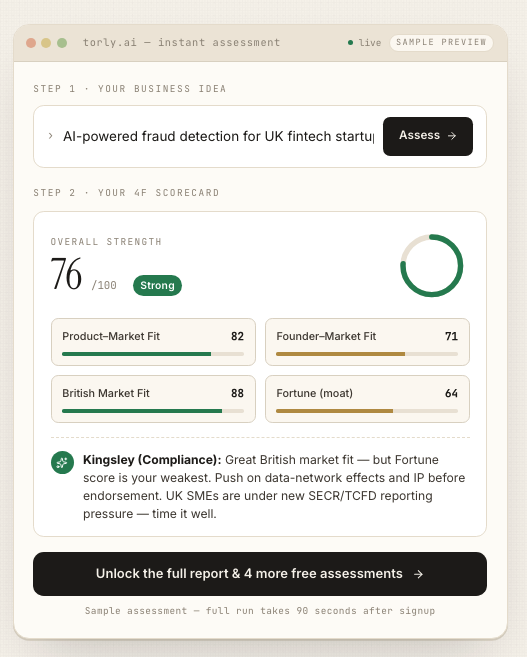
Building a watertight visa business model takes time. That’s where Torly.ai steps in. It’s an AI-driven platform designed for Innovator Founder Visa readiness. Here’s what it does:
- Business Idea Qualification: Validates innovation, viability and scalability against UK Home Office and endorsing body standards.
- Applicant Background Assessment: Analyses your experience and entrepreneurial flair to gauge endorsement likelihood.
- Gap Identification and Action Roadmap: Pinpoints weaknesses, then offers tailored recommendations on tech, team structure, market strategy and more.
Think of it as having an expert panel available 24/7. You get real-time scoring, feedback and a step-by-step plan to shore up your visa business model. And to work offline, you can even Download the BP Build Desktop APP for instant guidance wherever you are.
Practical steps to refine your business model
Let’s tie it all together with an action list:
- Review ENDORSE data and pull out top three stats.
- Draft a phased rollout plan with clear milestones.
- Map UK patient population and NHS budget impact.
- Use Torly.ai to score your draft plan.
- Iterate based on the gap report.
- Finalise your pitch deck and business plan.
With each tweak, you strengthen your case. And if you need hands-on creation, Build Your Endorsement Application with 6 AI Agents for a guided, stepwise build of your documents.
Around halfway through your prep, it helps to get a fresh perspective. That’s when you bring in a second dose of AI support to optimise and check compliance. Optimize your visa business model with AI assistance
Real-world success stories
“I thought assembling statistics was the hard part. Torly.ai turned it into a breeze. The ENDORSE insights fit perfectly and my draft scored 92% on innovation. I haven’t felt this confident since graduation.”
— Dr Anjali Mehta, CEO of CardioTrack
“Using patient adherence figures from ENDORSE, I mapped cost-savings for the NHS. Torly.ai highlighted gaps in my marketing strategy and gave me bulletproof wording. My endorsement came through in four weeks.”
— Michael Riley, Founder of GlycoGuide
Conclusion: Next steps to Innovator Visa success
If you want a visa business model that stands up to scrutiny, leverage robust clinical data and intelligent guidance. Start by mining the ENDORSE study for hard facts. Then structure your application around innovation, scalability and economic impact. Finally, plug in Torly.ai to validate and refine every detail.
Ready to take the next leap? Kickstart your visa business model with Torly.ai today