Payment Security and Fraud Prevention · September 9, 2026
Mitigating Commercial Risk: How Torly.ai Validates Your Fintech Business Model for UK Endorsement
Discover how Torly.ai evaluates financial transaction integrity and business risk to build robust, endorsement-ready UK Innovator Founder Visa applications.


Why Most Fintech Visa Applications Fail Before They Even Start
Securing endorsement for a UK Innovator Founder Visa is brutally competitive. If you are pitching a financial technology startup, the bar sits even higher. UK endorsing bodies do not just want to see a clever app or an ambitious pitch deck; they want rock-solid proof that your commercial venture will survive the real world. In the fintech sector, that means demonstrating deep resilience against transaction fraud, regulatory headaches, and commercial volatility. If your numbers look flimsy or your risk mitigation strategy feels like an afterthought, your application gets tossed aside. Navigating these requirements demands more than standard immigration advice, which is why founders increasingly rely on an AI Visa Business Evaluator to test and stress-proof their business model against Home Office criteria.
Getting a rubber stamp requires satisfying three specific pillars: innovation, viability, and scalability. Many founders get obsessed with the innovation aspect, building complex concepts that sound revolutionary on paper. Yet, they crash out on viability because they cannot prove their transaction flows are secure or legally compliant. Endorsing bodies look straight through vanity metrics. They want to know your fraud chargeback tolerance, your customer verification procedures, and your unit economics under adverse conditions. To survive this scrutiny, you need an objective assessment system that exposes commercial blind spots before an endorsing panel finds them first.
The Reality of Financial Risk: What Endorsing Bodies Actually Look For
When assessing a fintech proposition, endorsing bodies look at risk through a commercial and operational lens. It is not enough to say you plan to accept global payments or process high volumes of microtransactions. You need to prove you understand the mechanics behind those flows.
Modern online infrastructure providers like Stripe show us that risk management is an active, continuous game. In modern payment gateways, machine learning engines evaluate every single charge, categorising transactions across distinct risk bands: normal risk, elevated risk, and high risk. If a startup ignores transaction risk prevention, chargebacks destroy profit margins and merchant accounts get frozen overnight.
When an endorsing body reviews your business plan, they ask practical questions:
- How does your platform manage fraudulent charge attempts without ruining user conversion?
- What happens when elevated risk payments slip through your payment intent pipeline?
- Can your operational cash flow withstand unexpected dispute fees and network fines?
- Does your team have the governance structure to adapt to shifting compliance standards?
If your plan simply lists projected revenue without accounting for payment security, processing fees, and fraud buffers, it will be labelled unviable. You can bridge this gap early by opting to Build your Business Plan NOW using intelligent planning software that accounts for operational reality.
The Stripe Radar Lesson: Machine Learning Versus Real-World Friction
To understand commercial viability, look at how modern payment processing handles threats. Tools like Stripe Radar analyse hundreds of signals on every transaction, including device fingerprints, behavioural cues, and historical card patterns across millions of businesses.
Radar categorises actions automatically:
1. Allow: Clean transactions passing all checks.
2. Review: Elevated risk transactions sent to a manual assessment queue.
3. Block: High risk attempts declined before hitting the financial network.
4. 3D Secure: Step-up authentication requested when signals indicate potential dispute.
Fintech founders often assume integrating a basic API solves all security concerns. It does not. An endorsing body wants to know how your specific venture configures these rules. What is your policy for manual review queues? How do your algorithms handle false positives? If your fraud controls block 15% of genuine customers, your customer acquisition cost doubles, ruining your unit economics.
Demonstrating that you understand technical friction shows commercial maturity. It proves you are not merely an engineer with an idea, but a business leader capable of steering an enterprise through real market pressures.
Moving Beyond Basic Document Templates
Traditional visa consultancy relies heavily on generic templates. A consultant might take an old software plan, tweak the executive summary, and paste your name onto it. That approach might have worked a decade ago, but today’s endorsing bodies spot cut-and-paste jobs immediately.
Modern endorsement evaluation requires a dynamic, intelligent appraisal of your entire venture. That is where Torly.ai changes the playing field. Instead of acting as a passive word processor, Torly.ai functions as an advanced reasoning platform designed to tear your business model apart and reconstruct it to institutional standards.
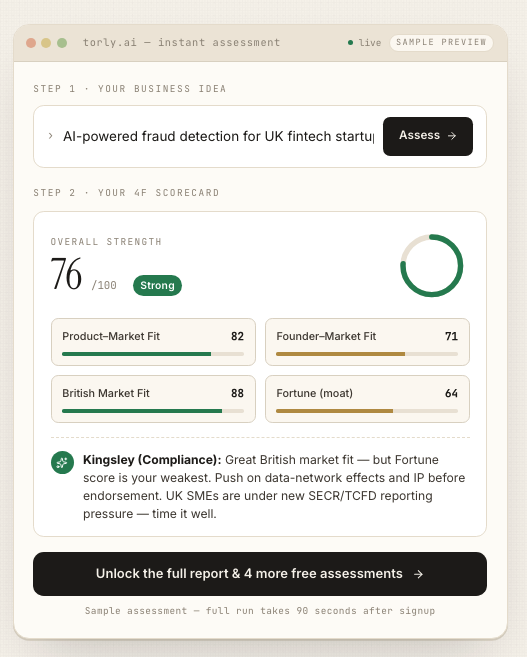
By running your data through our dedicated AI Visa Business Evaluator, you receive multi-layered scrutiny across your financial assumptions, target market positioning, and tech infrastructure. The system evaluates whether your fraud prevention protocols match standard industry practices, helping you present a credible, defendable model to endorsement panels.
The Problem With Human-Only Consultancy
Immigration lawyers understand statutory rules, but few have launched a tech startup. Business consultants understand pitch decks, but rarely know the granular rules enforced by UK endorsing bodies. This divide leaves founders stuck in the middle, paying thousands of pounds for advice that lacks technical depth.
Torly.ai combines both worlds. It measures your background, technical architecture, and financial roadmap against thousands of data points from previous endorsement outcomes. Instead of waiting weeks for high-level feedback, founders get instantaneous, actionable roadmaps that highlight commercial vulnerabilities before submitting documents.
How Torly.ai Validates Your Fintech Architecture
Torly.ai approaches your business plan the same way an institutional seed investor or endorsing assessor would. It breaks down your business into core structural components and evaluates each one against current regulatory expectations.
You can streamline this preparation by using the TorlyAI BP Builder APP, deploying specialised reasoning agents to test your assumptions in real time.
1. Business Idea Qualification (Innovation and Scalability)
Torly.ai checks whether your fintech solution offers genuine innovation or simply repackages existing payment rails. If you claim your platform uses adaptive AI models for fraud detection, the system checks whether your tech stack, data pipelines, and architectural diagrams actually support that claim.
2. Viability and Commercial Risk Auditing
Just as fraud engines categorise payments into normal, elevated, and highest risk, Torly.ai evaluates the commercial viability of your plan. It reviews your operational cost model, customer acquisition strategy, and legal compliance structures. If your financial forecast assumes zero transaction losses or unrealistically low churn, the platform flags these as high-risk anomalies that require immediate fixing.
3. Founder Suitability and Track Record
Do your skills match the complexity of your proposed business? If you are proposing an advanced cross-border settlement engine but your background shows zero experience in finance, compliance, or software architecture, endorsing bodies will hesitate. Torly.ai analyses your entrepreneurial profile, highlighting strengths and offering concrete recommendations to bridge experience gaps before your interview.
If you are ready to construct your portfolio systematically, you can Build your Business Plan NOW to eliminate guesswork and align with endorsing expectations.
Step-by-Step Risk Mitigation for Fintech Founders
To turn an ambitious fintech concept into an endorsement-ready submission, you must systematically de-risk your commercial proposition. Here is the operational checklist every founder should follow:
- Define Transaction Safeguards: Detail exactly how your platform intercepts fraud. Reference established industry patterns, such as 3DS step-up authentication, behavioural anomaly detection, and automated blocklists.
- Model Realistic Margins: Never project net revenues using gross transaction values. Deduct interchange fees, gateway margins, dispute costs, and fraud review overheads directly within your financial models.
- Establish Data Governance: Show compliance with UK GDPR and relevant financial conduct principles. Clarify how user transaction histories, identity verification records, and payment credentials are encrypted and stored.
- Identify Market Gaps Clearly: Explain why established players cannot simply duplicate your product with a minor software update. What proprietary data, unique network effect, or novel operational workflow protects your position?
Taking the time to address these structural components transforms your plan from an unverified pitch into an institutional-grade business proposition.
The Competitive Edge of Intelligent Preparation
The UK tech landscape remains one of the best places in the world to launch and scale a business. However, the UK Innovator Founder Visa route is intentionally rigorous. It filters out speculative concepts to ensure only high-growth, high-value enterprises secure endorsement.
Relying on luck or surface-level document drafting is a recipe for rejection. By working with our comprehensive AI Visa Business Evaluator, you gain an intelligent partner that spots flaws, stress-tests your commercial logic, and ensures your documentation meets strict endorsing body standards. Prepare your venture thoroughly, protect your commercial model, and present an application that endorsement bodies can approve with confidence.