Public R and D Funding and Policy Analysis · September 14, 2026
Navigating Public R&D Mandates: AI-Powered UK Innovator Visa Application Assistant for Policy Compliance
See how AI-Powered UK Innovator Visa Application Assistant analyses government research priorities to confirm your innovation strategy satisfies Home Office requirements and UK endorsing bodies effortlessly.


Why National Priorities Dictate Your Endorsement Chances
Securing an endorsement for the UK Innovator Founder Visa is no longer just about showing a viable commercial idea; it demands solid UK public R&D policy alignment. Endorsing bodies do not review applications in a vacuum. Instead, they examine whether your proposed venture supports the broader economic strategy of the United Kingdom. When the Department for Science, Innovation and Technology (DSIT) earmarks billions for semiconductors, AI safety, advanced materials, and life sciences, endorsing bodies take direct note. If your venture mirrors these national research priorities, your odds of securing an endorsement increase dramatically. To prove this connection early on, founders are turning to an AI-Powered UK Innovator Visa Application Assistant to spot regulatory mismatches before submitting their business plans.
Most international entrepreneurs fail this step because they look only at customer traction and ignore public policy direction. In reality, proving genuine innovation under Home Office standards requires showing how your business creates technological value within the domestic ecosystem. By understanding how public sector investments, funding mechanisms, and government-backed institutes shape the market, you can position your startup as a vital asset to Britain. Bridging this technical gap requires continuous verification, clear market positioning, and a solid understanding of UK endorsing body benchmarks.
The Real Shift in UK Public R&D Mandates
The UK government has altered how it funds and nurtures domestic technology. A clear example is the creation of the UK Semiconductor Institute, formed after extensive research by DSIT and academic partners like IfM Engage at the University of Cambridge. The initiative proved that the UK cannot merely fund random tech ideas; it must direct capital into critical infrastructure, compound semiconductors, silicon prototyping, and advanced packaging.
When public bodies spend over a billion pounds building an ecosystem, endorsing bodies are instructed to look for entrepreneurs who fit into that puzzle.
What does this mean for you as a founder?
- Your technology must solve real bottlenecks in the UK supply chain.
- Simply building a basic software wrapper around an existing API will not satisfy technical novelty requirements.
- You need to demonstrate how your intellectual property strengthens domestic technical capability.
- Alignment with published DSIT roadmaps provides instant credibility during your viability checks.
If your startup operates within deep tech, clean energy, or hardware, ignoring these published strategies is a massive mistake. You are pitching to organisations whose primary metric is delivering economic growth aligned with ministerial objectives. When your documentation reflects these national targets, endorsing bodies see an applicant who is prepared to contribute immediately to the domestic innovation pipeline.
Decoding the Home Office Criteria Through a Policy Lens
The Home Office mandates three core pillars for the Innovator Founder Visa: Innovation, Viability, and Scalability. Every applicant knows these words, yet thousands receive rejections each year. The issue lies in interpretation.
1. Innovation
To the Home Office, innovation does not mean slightly better customer support. It means showing a genuine market advantage or proprietary process that does not readily exist in the UK. By evaluating your work against national industrial roadmaps, you prove that your solution fills an acknowledged market gap.
2. Viability
Can the product actually be built, and can you run the enterprise? Viability looks at your operational roadmap and your personal capability. If you are developing advanced hardware or algorithms, you must prove you have access to local testing infrastructure, university labs, or domestic supply chains.
3. Scalability
Scalability is where policy alignment really shines. The UK does not just want businesses that survive; it wants ventures that create high-skilled domestic jobs and export British technology abroad. Linking your commercial pipeline to high-growth sectors identified by public research studies shows you are building for long-term growth.
To streamline this process and ensure your proposal hits every milestone, you can Build your Business Plan NOW using intelligent planning workflows designed around current endorsing criteria.
Why Manual Business Planning Falls Short
Writing a visa-compliant business plan used to take months of painful drafting, expensive legal consultations, and trial-and-error edits. Even then, traditional solicitors rarely possess the technical background required to evaluate whether a deep-tech architecture fits UK industrial goals.
Here is where standard approaches run into trouble:
- Static Information: Immigration policies and endorsing body rubrics change quickly. Traditional business plans rely on outdated templates that do not reflect recent DSIT directives.
- Superficial Market Analysis: Standard consultants often perform shallow market research, quoting generic global numbers instead of specific UK cluster data.
- Lack of Technical Depth: Generalist advisors struggle to document proprietary IP, data privacy frameworks, or advanced engineering pipelines effectively.
Navigating these challenges requires dynamic evaluation. Relying on an advanced UK Innovator Gap Analysis allows you to uncover weaknesses in your commercial assumptions, founder credentials, and policy links before you face a panel of endorsement assessors.
How Agentic AI Bridges the Compliance Gap
Recent advances in artificial intelligence have changed how applicants prepare their visa submissions. Rather than relying on simple text generators, specialized platforms employ multi-agent architectures where distinct AI reasoning models handle specific parts of the assessment.
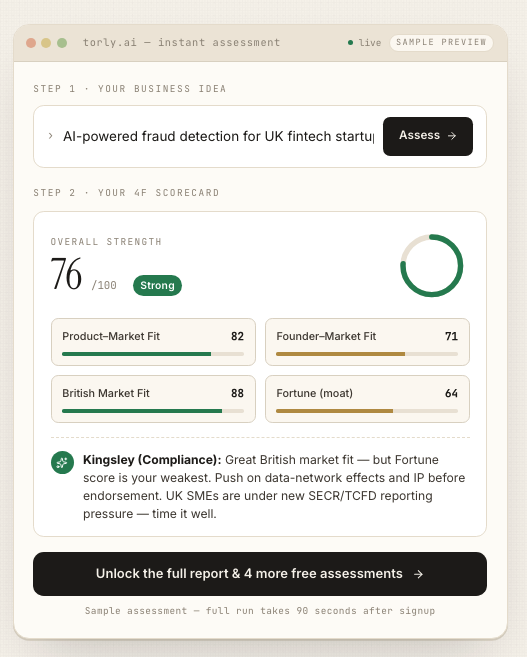
Imagine having a dedicated analyst evaluating your venture against the exact criteria used by UK endorsing bodies:
These specialized reasoning agents run automated stress-tests on your submission. One agent checks your intellectual property claims against existing UK patents. Another reviews your financial models to ensure hiring projections match standard UK wage levels. A third agent examines your operational strategy to confirm that your supply chain and R&D ambitions match current government roadmaps.
To take full advantage of this coordinated analysis, ambitious founders rely on the TorlyAI BP Builder APP to turn early concepts into fully compliant, endorsement-ready submissions using six specialized agents and dozens of purpose-built skills.
Conducting a Systematic Readiness Assessment
Before you send your documents to an endorsing body, you must perform an objective readiness check. Ask yourself these practical questions:
- Does the problem appear on public sector priority lists? If DSIT or UK Research and Innovation (UKRI) are running active funding competitions in your domain, your problem statement is validated.
- Where does your R&D take place? If you plan to partner with British universities, Catapult centres, or regional tech clusters, state this explicitly in your documentation.
- Can you prove founder-market fit? Your background must prove you can execute the plan. Your technical credentials, past commercial exits, or domain publications must align with your role.
- Is your financial model realistic for the UK market? Projections must account for UK corporation tax, national insurance contributions, domestic office spaces, and realistic development cycles.
By systematically addressing each point, you remove subjectivity from your application. The goal is to make it easy for an endorsing body officer to tick every box on their assessment sheet.
The Advantage of Continuous Feedback Loops
Visa regulations never stay still. Endorsing bodies frequently update their internal evaluation frameworks based on feedback from the Home Office and evolving economic demands. Traditional visa consulting firms struggle to keep up with these continuous shifts, often relying on strategies that worked two years ago but fail today.
Modern platforms maintain continuous feedback loops. By analysing trends across hundreds of application cycles, agentic systems recognise emerging patterns in how assessors evaluate commercial viability and technical risk. When an endorsing body tightens scrutiny on international client contracts or software uniqueness, the AI adjusts its scoring parameters instantly.
This real-time responsiveness gives you a measurable advantage. Instead of discovering an oversight during a formal rejection interview, you resolve compliance issues while drafting your core narrative.
Positioning Your Venture for Long-Term UK Success
Securing your endorsement letter is an incredible milestone, but it is ultimately the first step of a longer journey. The Innovator Founder Visa requires formal checkpoints at month 12 and month 24, where endorsing bodies verify that your startup is meeting its commercial and developmental targets.
Building your strategy around genuine public policy priorities ensures you remain compliant long after your initial entry stamp. When your business supports domestic research objectives, you gain access to a broader ecosystem of Innovate UK grants, regional angel syndicates, and public accelerator programs. You transform your startup from an external applicant into an essential contributor to the British economy.
Taking control of this process requires objective analysis, precise documentation, and continuous validation. Start reviewing your venture against rigorous regulatory standards today through the AI-Powered UK Innovator Visa Application Assistant, and ensure your innovation journey starts on solid ground.