General UK Visa Guides · September 7, 2026
UK Entrepreneur Routes Explained: Preparing for Endorsement with Torly.ai
Explore the pathways for UK entrepreneurial entry and discover how Torly.ai validates your business viability and founder fit before you apply.


Navigating the UK Immigration Maze: Why Smart Founders Plan Early
Setting up a business in Britain sounds brilliant until you open the Home Office rulebook. Years ago, options like the Prospective Entrepreneur route or the Tier 1 Entrepreneur visa gave foreign founders a foothold, but policies change quickly. Today, legacy routes have been replaced by the Innovator Founder visa. If you want to build here, your pitch must survive strict scrutiny from official endorsing bodies. Crafting an ironclad UK Startup Visa Business Plan is no longer just about showing cash in the bank; it requires presenting an innovative, scalable, and fully viable business concept that checks every single regulatory box.
Most foreign founders fail before they even submit an application. Traditional legal firms often take months, charge thousands of pounds, and focus entirely on the legal paperwork while ignoring the actual market mechanics of your pitch. This leaves an enormous gap between legal advice and commercial realism. By adopting an evaluation-driven approach, you can systematically stress-test your enterprise model, match endorsing body expectations, and refine your pitch well before walking into an endorsement panel.
What Happened to the Old Entrepreneur Routes?
Let us clear up some confusion. A lot of old guidance online still talks about the Prospective Entrepreneur visa or the Start-up visa. The Prospective Entrepreneur route, which let people enter on a visitor visa to pitch to venture capital firms, was folded into the standard visitor rules. Soon after, the Start-up visa closed to new applicants, leaving the Innovator Founder visa as the primary route for ambitious international founders.
Under the current setup, you do not need £50,000 in investment funds to qualify. That sounds great on the surface. But do not celebrate just yet. The Home Office shifted the heavy lifting onto independent endorsing bodies. These bodies do not care about generic consultancies, local retail shops, or standard trading companies. They want disruptive technology, scalable intellectual property, and measurable economic growth for the United Kingdom.
If you are just starting your market research, you must Build your Business Plan NOW around the three official criteria: innovation, viability, and scalability. Miss even one, and your endorsement letter will not arrive.
The Three Core Pillars: Innovation, Viability, and Scalability
Endorsing bodies evaluate your submission against three distinct standards. Getting these right requires genuine commercial insight:
- Innovation: You cannot simply launch a business that already exists in the market. You must demonstrate a genuine, original business proposition. Is there proprietary technology? Are you solving an old problem with a novel, defensible mechanism?
- Viability: Does your enterprise actually work on paper and in practice? The endorsing body will assess your background, market tests, supply chain, margins, and operational capacity. They want to see that you possess the exact skills necessary to pull this off.
- Scalability: A steady lifestyle business will be rejected. You must provide evidence of structured planning, realistic job creation for British workers, and potential for international expansion.
A classic mistake is presenting a standard business proposal stuffed with legal jargon. Endorsing bodies review hundreds of pitch decks each month. They can spot weak financial assumptions or vague marketing plans in seconds.
Traditional Immigration Solicitors vs Modern AI Evaluation
Law firms like Edmans & Co or other traditional immigration consultants have spent decades managing visa filings. Their strength lies in compliance, drafting formal cover letters, and ensuring your passport forms are filled out correctly.
However, traditional legal consultancies have glaring limitations when it comes to early-stage business analysis:
- Astronomical Hourly Rates: Paying hundreds of pounds per hour for basic consultations is an expensive way to workshop a tech product.
- Lack of Technical Savvy: A solicitor understands immigration rules, but they rarely understand code architectures, SaaS metrics, or unit economics.
- Slow Iteration Cycles: Waiting two weeks for a partner to review a draft business plan slows you down when time is critical.
This is where next-generation tools bridge the divide. Instead of guessing whether your deck satisfies an endorsing officer, modern evaluation platforms review your idea through a commercial lens. Rather than spending thousands on generic advice, you can use an intelligent AI-Powered UK Innovator Visa Application Assistant to identify fatal weaknesses in your proposition within minutes.
Traditional law firms still have their place for administrative filings, but using them to invent your business strategy is like hiring an accountant to design your website. You need specialized commercial validation first.
Inside the Technology: How Torly.ai Redefines Founder Readiness
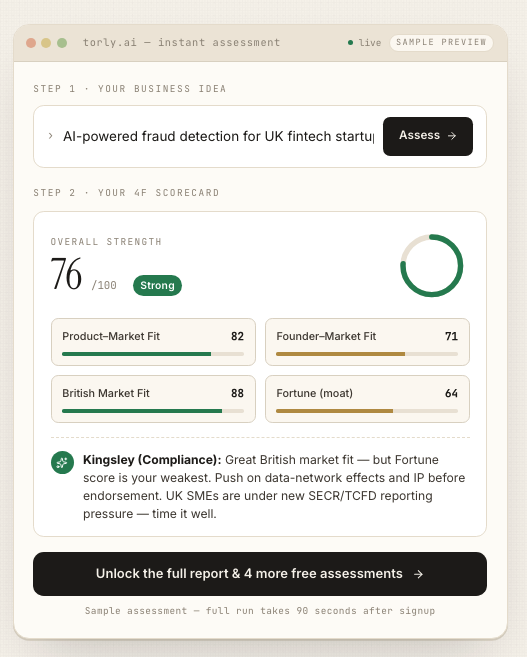
Torly.ai was engineered to remove the guesswork from endorsement applications. Powered by advanced AI reasoning models, the platform acts as an intelligent visa readiness analyst, business evaluator, and strategic improvement partner.
Instead of generic text generators that spit out unhelpful templates, the system conducts multi-layered evaluations across three critical dimensions:
1. Business Idea Qualification
The platform measures your venture against actual endorsing body precedents. It dissects your core value proposition to determine whether your product offers genuine differentiation or merely clones existing UK solutions.
2. Applicant Background Assessment
An idea is only as good as the person executing it. The system analyses your track record, professional skills, and operational capabilities to ensure founder-market fit. If the endorsing body will perceive you as underqualified, you will find out early.
3. Gap Identification and Action Roadmap
Getting a rejection hurts; knowing how to fix the problem beforehand is priceless. The platform generates practical roadmaps covering your market positioning, technology stack, and team hiring strategy.
You can try the TorlyAI BP Builder APP to see how structured guidance speeds up the drafting process, moving your concept from an initial spark to a comprehensive operational plan.
Practical Steps to Build an Endorsement-Ready Plan
If you want to secure an endorsement on your first attempt, follow this systematic workflow:
Step 1: Stress-Test Your Value Proposition
Ask yourself the hard questions before an endorsing committee does. Why must this business exist in the UK? What barrier to entry stops a local competitor from copying your system tomorrow?
Step 2: Validate the Unit Economics
Endorsing bodies want detailed financial forecasts. This includes realistic cash flow projections, customer acquisition cost calculations, lifetime value metrics, and salary expenditures. Avoid ridiculous hockey-stick revenue graphs that have zero backing data.
Step 3: Align Your Founder Profile
Highlight your direct contributions. Show how your past work relates to the product you are creating. If you lack technical skills, present a clear plan for your technical co-founder or development partners.
Step 4: Map Compliance and Regulatory Steps
Depending on your industry, you might need FCA registration, GDPR data auditing, or health and safety certifications. Acknowledge these requirements openly in your documentation to prove operational maturity.
To save time drafting each chapter from scratch, founders can takes you from idea to endorsement-ready business plan. 6 specialised agents. 31 skills. directly to automate complex market research and financial tables without losing human authenticity.
Overcoming the Common Pitfalls
Even skilled business leaders make preventable mistakes during the Innovator Founder visa process:
- Over-relying on generic AI copy: Copying text straight out of broad AI chat windows leads to shallow, unconvincing plans that get tossed out quickly.
- Ignoring the endorsing body’s unique focus: Some endorsing partners favour green technologies, while others prefer healthcare or deep tech. Tailoring your language matters.
- Vague hiring schedules: Stating that you will hire staff without listing job roles, salary bands, and national insurance calculations looks amateurish.
By addressing these pitfalls systematically, your documentation will stand out from the thousands of low-effort applications submitted every quarter.
Turn Your British Startup Vision into Reality
The path to building a company in the UK has never been more competitive, but the rewards are massive. With access to world-class capital, exceptional talent, and a thriving innovation ecosystem, the United Kingdom remains a premier destination for ambitious entrepreneurs.
Success comes down to preparation. You do not need to stumble through outdated immigration advice, pay massive legal retainers, or submit an untested business proposition. By leveraging the advanced intelligence of an AI-Powered UK Innovator Visa Application Assistant, you can pinpoint your application weaknesses, refine your commercial strategy, and present an endorsement application that demands attention. Take control of your UK expansion today.