Duke Harewood
TorlyAI 创始人。他正在为英国创新者创始人签证(Innovator Founder Visa)申请者构建 AI 驱动的工具,灵感来源于他本人亲历背书(endorsement)申请全程所积累的实战经验。
Duke Harewood 的文章
Working capital: modeling growth without running out of cash
A profitable, growing business can still run out of cash. The cash conversion cycle explains why — and how to model it before it catches you.
Financial model red flags endorsing bodies flag first
The seven financial-model mistakes that damage credibility fastest in an Innovator Founder business plan — why each one costs you, and the fix for every red flag.
Will settlement take 10 years? What earned settlement means for founders
A 2026 white paper proposes extending UK settlement to 10 years. Innovator Founders may be spared under an "earned settlement" carve-out — here's what is confirmed and what is only proposed.
Building revenue assumptions assessors won't reject
A driver-based revenue model — leads, conversion, price, churn — is defensible under endorsement scrutiny in a way a single top-line growth rate never is. Here's how.
From financial fluency to your visa financial model
The Financial Fluency series capstone: how P&L, cash flow, ratios, break-even, and budgeting connect to the I-P-O-C model your endorsement assessor expects.
Budgeting methods: zero-based, rolling, top-down vs bottom-up
Zero-based, rolling, top-down, bottom-up, incremental, value-based: every budgeting method explained and matched to your startup's stage and needs.
Management reporting: board packs, scorecards & flash reports
The reports that run a company: how month-end variance analysis, balanced scorecards, board packs, and flash reports turn numbers into decisions.
What 10 jobs actually cost: modeling job creation in your BP
The Innovator Founder settlement criterion needs 10 jobs. Model the loaded cost — wages, employer NI, pension — and a realistic hiring timeline, or your BP won't add up.
Gearing & coverage ratios: how much debt is too much?
Learn how gearing and interest coverage ratios measure debt risk — and why lenders and visa endorsers need to see a business that can handle what it owes.
Sensitivity analysis: stress-testing your visa financial model
Endorsing bodies reject overconfident projections. Showing a downside, base and upside case with clear assumptions signals you have thought about risk, not hoped.
Liquidity & efficiency ratios: can you pay the bills?
Understand current ratio, quick ratio, debtor days, and creditor days — the liquidity and efficiency ratios that warn you before a cash shortfall strikes.
Profitability & growth ratios: are you making money?
Decode gross margin, operating margin, net profit margin, and return on capital — five ratios that reveal whether your UK startup is truly making money.
Blockchain & crypto in your accounts: what founders should know
Holding crypto or accepting on-chain payments? Here is how digital assets appear in your accounts, how reconciliation tools work, and what HMRC expects.
Cloud accounting: getting investor-ready with Xero
Real-time cloud accounting gives founders financial control, clean audit trails, and investor-ready reports from day one. Here is how to set up right.
Double-entry bookkeeping explained (without the jargon)
Double-entry bookkeeping records every transaction twice, keeping your books balanced. Here is what that means, with a worked example any founder can follow.
The accounting equation: Assets − Liabilities = Equity
Assets minus liabilities equals equity — one equation governs every balance sheet ever produced. Learn what each term means and why the equation always balances.
GAAP for founders: the principles behind your numbers
UK GAAP governs how company accounts are prepared. These seven principles — accruals, prudence, going concern and more — explain the rules behind every number in your financials.
R&D tax credits, Patent Box & capital allowances for innovators
R&D tax credits, Patent Box and capital allowances let innovative UK companies keep more of what they earn. This guide explains how each scheme works and what qualifies.
Paying yourself: salary vs dividends and the tax trade-off
Salary or dividends? UK founder-directors of limited companies navigate income tax, National Insurance, the low-salary-plus-dividends split, and the Employment Allowance exclusion for sole directors.
VAT for founders: thresholds, schemes & registering early
Everything UK founders need to know about VAT: the registration threshold, output vs input VAT, the Flat Rate Scheme, voluntary registration, and the cash-flow trap to avoid.
Corporation Tax basics: rates, deadlines & what's taxed
How Corporation Tax works for UK limited companies: taxable profit, the small-profits and main rate, key deadlines, CT600 filing, and reliefs that reduce your bill.
Statutory accounts vs management accounts
Learn the difference between statutory accounts (filed publicly at Companies House) and management accounts (monthly internal reports) — and why Innovator Founders need both.
A year in the life of a UK company: the filing calendar
A practical guide to every annual filing deadline for UK limited companies: confirmation statement, accounts at Companies House, and corporation tax return and payment.
Why Innovator Founders should incorporate a UK limited company
Discover why incorporating a UK limited company is the right move for most Innovator Founders — from limited liability and SEIS eligibility to tax efficiency.
Financial planning & budgeting (FP&A) for founders
FP&A turns strategy into numbers. Learn how founders build a budget, track actuals versus plan, and choose the right budgeting approach for their stage.
Break-even & contribution analysis: the key number
Contribution margin and break-even are the two numbers that show how much you must sell before your business stops losing money. With a worked example.
Financial ratios 101: turning numbers into insight
Financial ratios translate raw numbers into business insight. Learn the seven key ratio categories every UK startup founder needs to assess financial health.
How the three financial statements interlink
The P&L, balance sheet and cash flow statement are three windows on the same business. Learn how they connect and why investors always read all three together.
The Cash Flow statement: why profit isn't cash
Profit on your P&L does not pay your suppliers. The cash flow statement reveals where money really went and how long your startup can survive on its current runway.
The Balance Sheet: what your company owns and owes
The balance sheet is a financial snapshot: everything your company owns, everything it owes, and what is left for shareholders. Here is how to read one.
The Profit & Loss statement: reading your performance
The Profit & Loss statement summarises your business performance over a trading period. Learn to read revenue, gross profit, operating profit, tax, and retained profit line by line.
Allowable expenses: the 'wholly & exclusively' rule
The 'wholly and exclusively' test is HMRC's rule for deducting business expenses. Understand allowable vs disallowable, benefit-in-kind traps, and why receipts matter for six years.
SEIS, EIS & VCT: the UK tax reliefs that pull in investors
SEIS, EIS and VCT give investors generous income-tax and CGT relief on UK startup investment. Understanding these schemes helps founders raise money and signal viability.
The UK tax map: Corporation Tax, VAT, Income Tax & NI
Corporation Tax, VAT, Income Tax, and National Insurance all affect UK startups differently. A plain-English map of who pays what and when — for founders, not accountants.
Becoming a UK company director: your legal responsibilities
As a UK limited company director you are legally responsible for records, accounts, and tax — even when you delegate the admin. Here's what that means in practice.
Sole Trader, Ltd, LLP or PLC: choosing your UK business structure
Sole trader, partnership, LLP or limited company? For UK Innovator Founder Visa applicants, the structure you choose affects liability, tax, and investor access.
Deterministic, not hallucinated: the rule for AI in visa financials
An AI chatbot will happily invent your revenue forecast; an endorsement assessor will catch it. Why visa financials must be deterministic — and how to spot hallucinated numbers.
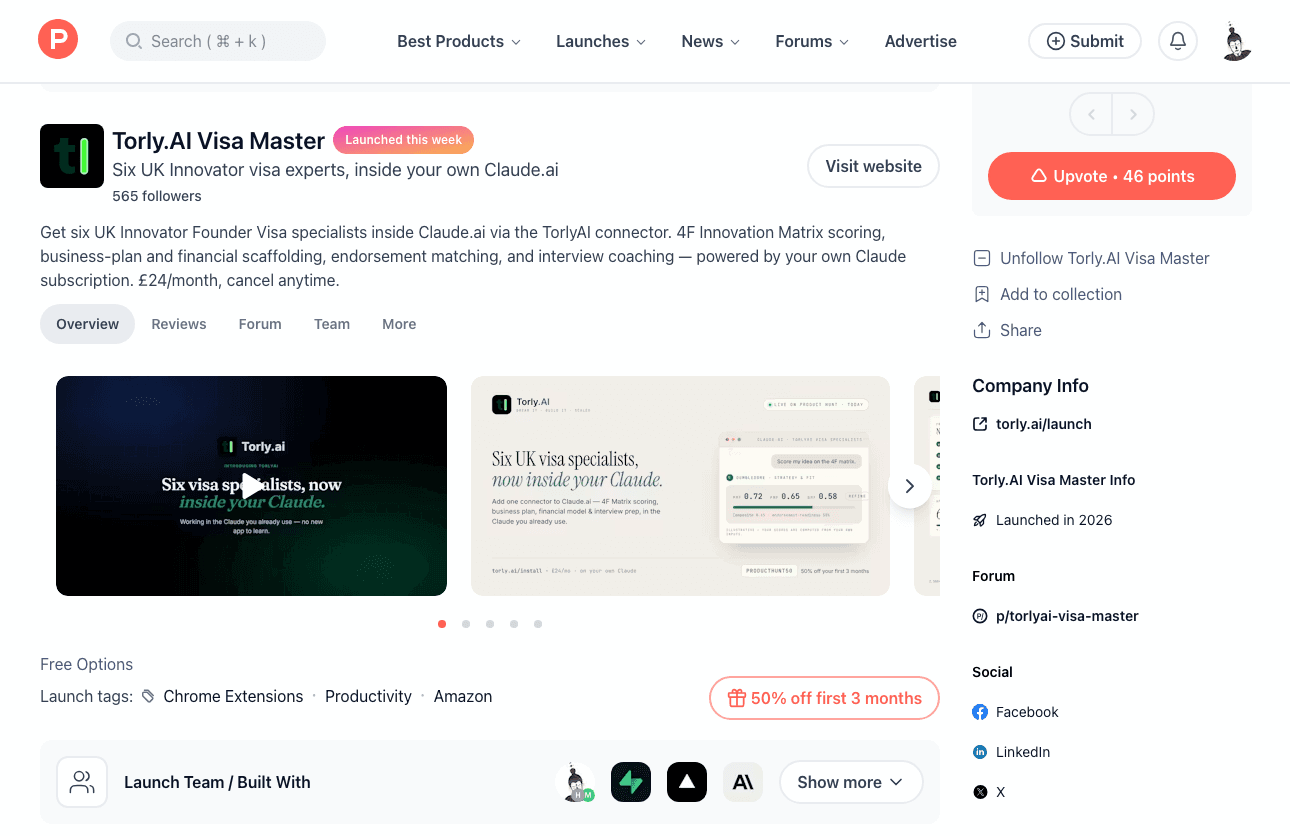
The six roles every Innovator Founder Visa applicant needs
Endorsement prep is not one job but six — from 4F strategy to interview coaching. Here is the framework of support a strong application needs, however you choose to resource it.
Validating a UK visa idea in public: lessons from our launch
The Innovator Founder Visa demands proof your idea meets a market need. A public launch is the fastest test — here is what ours revealed about evidencing demand before you apply.
The 4 stages of an Innovator Founder Visa
Every Innovator Founder Visa founder moves through four stages — Learner, Explorer, Doer, Leader. Here is the job at each, and how to get endorsement-ready.

The Learner: start your Innovator Founder Visa
New to the UK Innovator Founder Visa? Learn the route and validate the basics for free before you commit time or money — and get an instant 4F baseline.

The Explorer: test your idea inside Claude
Already use Claude.ai? Bring six Innovator Founder Visa specialists and 4F Matrix scoring into your own Claude to pressure-test your idea and find the gaps before an endorsing body does.

The Doer: build an endorsement-ready plan fast
For the founder ready to go for endorsement: how the TorlyAI Desktop app's six AI agents build an endorsement-ready Innovator Founder Visa package fast.

The Leader: a done-for-you path to endorsement
For the time-poor founder who'd rather lead than do the paperwork: how a done-for-you path assembles the whole Innovator Founder Visa endorsement.

TorlyAI is now in Claude: your visa specialists, inside Claude.ai
TorlyAI's six UK Innovator Founder Visa specialists are now a connector you add to Claude.ai in about a minute — 4F scoring, plan structure, £24/month.

Preparing for the endorsement interview with an AI coach
How to prepare for the Innovator Founder Visa endorsement interview — the questions, the failure modes, and how an AI coach rehearses you against them.

Why generic AI fails visa business plans — and what to use
Can you use ChatGPT for an Innovator Founder Visa business plan? Where generic AI breaks the endorsement, the mistakes it makes, and what to use instead.

UKES, Innovator International or Envestors — choosing your body
How to choose between the UK Innovator Founder Visa endorsement bodies — what each weights, who they suit, and how to match your idea to the right one.

The 4F Innovation Matrix, explained
How an Innovator Founder Visa idea is scored: Product, Founder, and Business fit times a Fortune factor — the four dimensions endorsing bodies test for.

Build your Innovator Founder Visa business plan inside Claude
How to write an Innovator Founder Visa business plan with AI without producing the buzzword-stuffed document assessors reject — using structure, not generation.

Ireland visa vs UK Innovator Visa: insights for entrepreneurs
Ireland's STEP and the UK Innovator Founder Visa look similar — but the capital test, endorsement gate, and settlement timelines diverge sharply.

Fabricated endorsement letters: the fraud warning assessors keep seeing
Innovator International has seen fabricated emails, fake endorsement letters, counterfeit refusals. Here's how the fraud works — and how to protect yourself.

Drafting the perfect endorsing body letter with AI assistance
Endorsement letters are issued by the endorsing body, not drafted by the applicant. What the letter contains, where AI legitimately helps, and the fraud risk.

The outsourcing red flag: why offshoring core tech kills applications
Outsourcing core tech to your home country is commercially rational and endorsement-fatal. Here's how to resolve the visa-logic conflict.

Ghost-written ideas and buzzword traps: why most applications fail
Innovator International's 28% endorsement rate is dragged down by ghost-written plans and buzzword-stuffed propositions. Here's how to spot the patterns.

Best AI business plan generator for the UK Innovator Visa process
Generic AI business plan tools fail the Innovator Founder Visa. What a visa-specific generator must do, and where off-the-shelf alternatives break.

Monthly trading reports: the discipline that keeps endorsements alive
Envestors requires a 2-page monthly trading report on its portal. Here's how to write one that keeps your account manager on side and your endorsement secure.

11 financial model templates for your UK Innovator Visa business plan
Eleven financial models that make an Innovator Founder Visa business plan defensible — three-statement, break-even, sensitivity, and eight more.

Letters of intent vs paying customers: what Envestors actually counts
Not all market evidence is equal. Envestors ranks paying customers first, then letters of intent, patent attorney opinions, and testimonials.

Co-founders, skill gaps, and in-house teams
Every founder has skill gaps. How you fill them determines whether your Innovator Visa clears — UK co-founders, in-house employees, and IP-owning teams.

Why 'viability of the applicant' is the #1 assessment factor
Scott Horton says the viability of the applicant — not the idea — is what Envestors weighs most. Here's what commercial track record looks like in assessment.

Architect of the innovation: when you're not the coder
You don't have to write the code. You do have to be the architect. Scott Horton's minimum bar for founder ownership of the innovation, and how to meet it.

Innovator Founder Visa success stories: AI-powered plans that get endorsed
Four anonymised Innovator Founder Visa success stories — what the endorsed applications had in common, and what the rejected ones got wrong.

The 20% Prince2 contingency: financial discipline that gets endorsed
Innovator International wants 20% contingency on top of your break-even forecast. Here's why project-management thinking beats optimism with assessors.

£100k per employee: the hidden scalability benchmark
Richard Harrison's rule: an Innovator Visa business should generate £100k revenue per employee per year. Here's how to structure your P&L so it clears.

The 24-month runway rule: what replaced the £50k
The old £50,000 Innovator Visa threshold is gone. What replaced it is stricter — 24 months of verified runway, and funds you can prove are already yours.

Top 5 AI tools for effortless visa documentation — and why TorlyAI stands out
Five AI tools applicants use to handle Innovator Founder Visa documentation — from passport photos to e-signatures — and where each one stops being useful.

The formal presentation interview: what assessors actually probe
Envestors' formal presentation interview is where ghost-written ideas get caught. Here's what the rigorous Q&A tests, and how to clear the authenticity bar.

The displacement test: why your idea must not replace a UK job
Innovator International rejected a packaging company on displacement grounds. The visa is for net economic contribution — here's how to pass the test.
Top 4 UK endorsing bodies for the Innovator Founder Visa in 2026
The three commercial endorsing bodies plus the one invitation-only programme — and how to pick the right fit for your Innovator Founder Visa application.

Weekly endorsement committee: how Envestors decides
Every week Envestors' endorsement committee reviews every application — chaired by a co-founder, scored against the rubric, with detailed written feedback.

Inside Innovator International's endorsement framework
Richard Harrison's innovation equation, the £100k-per-employee rule, and the Prince2 contingency — how Innovator International assesses visa applications.

How Envestors really assesses Innovator Founder Visa applications
Inside Envestors' three-pillar scorecard for Innovator Founder Visa applications — innovation, viability, scalability, with leeway between pillars.

Free AI-optimised Innovator Founder Visa business plan template
A seven-section Innovator Founder Visa business plan template built around what endorsing bodies actually score — not what generic templates pad out.