
Most founders ask the wrong question about endorsement prep. They ask "who can I hire to do this?" — when the better question is "what jobs actually need doing, and who or what is best placed to do each one?"
Endorsement prep is six jobs wearing one coat
When I started building TorlyAI, I kept meeting founders who treated "preparing for endorsement" as a single, monolithic task. So they'd reach for a single solution: a £5k–£15k consultant, a folder of templates bought from someone on a forum, or — increasingly — a generic chat with an AI that confidently wrote them a business plan with invented numbers.
All three fail for the same reason. Endorsement prep is not one job. It's six. And each one protects you against a different way applications fall over.
Here are the six roles every serious application needs filled — whoever fills them.
The six roles
1. The innovation strategist. This is the person (or process) that pressure-tests whether your idea is genuinely innovative, viable and scalable in the way endorsing bodies care about. At TorlyAI we frame this with the 4F Innovation Matrix — Product-Market Fit, Founder-Market Fit, Business-Model Fit and "Fortune" (timing/luck factors). The job is to find the weak corner of your case before an assessor does.
2. The business-plan writer. Someone who can turn your thinking into the structured document an endorsing body expects — innovation, market, scalability, team, financials — in their language, not yours.
3. The financial-modelling analyst. The one who builds three-year projections that actually add up: revenue assumptions, cost base, runway, headcount and the UK job-creation story. Numbers that survive a follow-up question.
4. The compliance checker. The role that reads your application the way an endorsing body might — against their published expectations — and flags where you've drifted, contradicted yourself, or left a criterion unaddressed.
5. The evidence assembler. Endorsement isn't only the plan; it's the supporting pack. This role gathers and orders the proof — market research, letters of intent, technical validation, CVs — so claims are backed, not asserted.
6. The interview-prep coach. The endorsement contact-point conversation is where vague applications unravel. This role rehearses you on the hard questions until your answers are crisp and consistent with what you wrote.
What each role does, and the failure it prevents
| Role | What it does | The failure it prevents |
|---|---|---|
| Innovation strategist (4F) | Scores innovation, viability, scalability; finds the weak corner | A "nice business" that isn't innovative enough to endorse |
| Business-plan writer | Structures your case in the body's expected format | A rambling plan that hides your strongest points |
| Financial-modelling analyst | Builds projections that reconcile and stress-test | Numbers that collapse under one follow-up question |
| Compliance checker | Reads against endorsing-body expectations | A missing or contradicted criterion you never noticed |
| Evidence assembler | Orders proof behind every claim | Assertions with nothing to back them |
| Interview-prep coach | Rehearses the contact-point conversation | A strong document undone by a shaky interview |
Build vs buy vs AI
Once you see it as six roles, the resourcing decision gets clearer. You're not choosing one supplier; you're choosing how to fill six slots.
- Buy (consultant): High competence, high cost (£5k–£15k is common), and — crucially — the competence leaves when they do. You learn little about your own case.
- Build (DIY with templates): Cheap, but you're now the strategist, writer, analyst, checker, assembler and coach. Most founders are genuinely good at two or three of these and quietly weak at the rest.
- Generic AI: Fast and cheap, but it will happily write you confident prose and invent financial figures. Great at language, dangerous at facts.
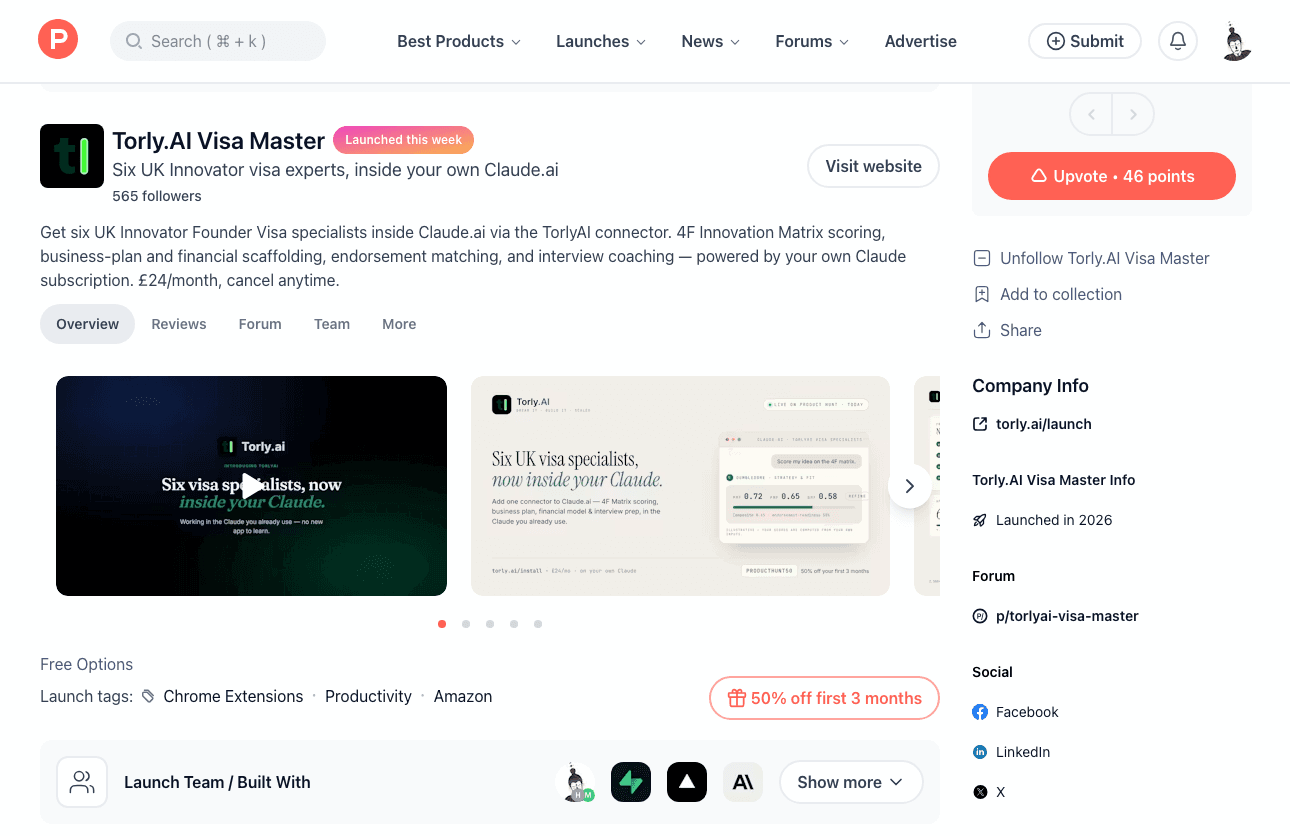
The trade-off we tried to resolve with TorlyAI Visa Master is a fourth option: put domain expertise inside the tool you already work in. It's an MCP connector for Claude — you add one connector and the six specialists appear as tools in the Claude you already use, at £24/month on your own subscription (there's also a free web tier with five assessments, no card).
The design principle matters more than the packaging. Claude does the writing; TorlyAI supplies the visa structure, the deterministic 4F scoring and the deterministic financial maths. So the language is fluent, but the numbers are computed, not hallucinated. That's the specific failure of generic AI that the six-role split is meant to close.
Expertise that lives inside the tool you already work in removes the friction that kills DIY prep — no context-switching, no re-explaining your business six times to six suppliers.
The hidden benefit: you become the founder assessors want
Here's the part the consultant route quietly costs you. The Innovator Founder Visa exists to back founders — people who can run, defend and scale the business. When you sit inside each of the six roles yourself, even with a tool doing the heavy lifting, you build exactly the competence an assessor is probing for.
You'll know your own numbers because you watched them computed. You'll answer the interview question because you wrote the answer, not your consultant. That's founder-market fit demonstrated, not claimed — and it's the difference between an application that describes a capable founder and one that is one.
On launch day, Visa Master reached #27 on Best of Product Hunt with 46 community upvotes, 3 comments and 565 followers. Modest numbers — but enough to tell us the six-role framing resonated with founders who'd felt the gaps themselves.
Know exactly where your application stands.
Get your free AI assessment in 90 seconds.
Get your assessmentKey takeaways
- Treat endorsement prep as six distinct roles, not one task: innovation strategy, business-plan writing, financial modelling, compliance, evidence assembly, and interview prep.
- Each role prevents a specific failure — map your weak slots honestly before deciding what to buy, build or automate.
- Generic AI is great at writing and dangerous at facts; insist on computed, not hallucinated numbers (deterministic 4F scoring and financial maths).
- Doing the six roles yourself — even with tooling — builds the founder competence assessors are actually testing for.
- Whatever you choose, fill all six slots. A strong document is undone by a weak interview, and a beautiful plan is undone by numbers that don't reconcile. See /install for how we packaged the six, and /insights for more.
- founder-profile
- endorsement
- business-plan
- interview-prep
- ai-tools