
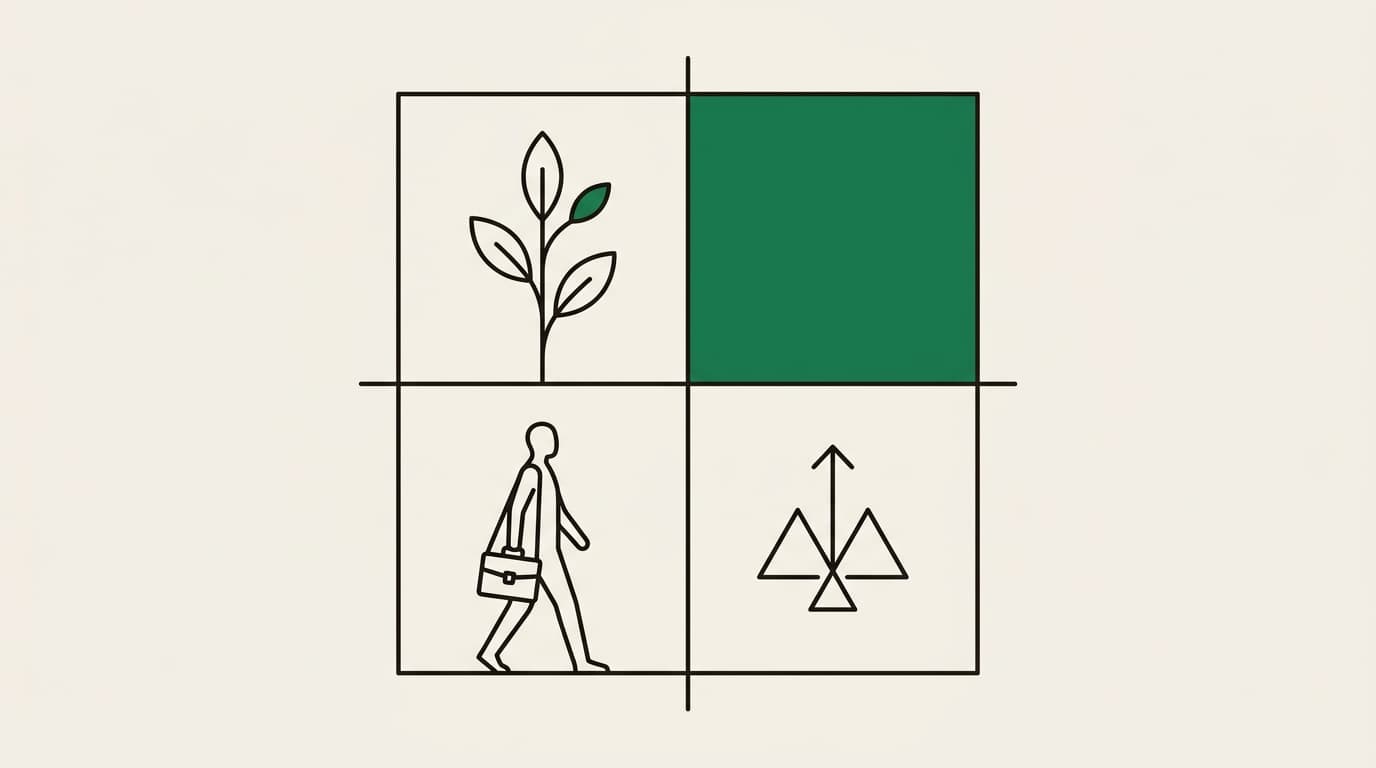
Founders preparing an Innovator Founder Visa application usually obsess over the idea — is it innovative enough, is it big enough, is it novel. But endorsing bodies do not score "the idea" as a single thing. They decompose it. The most useful way to model how they think is the 4F Innovation Matrix: three kinds of fit multiplied by a Fortune factor. Understanding the four dimensions — and the fact that they multiply rather than add — tells you exactly where your application is strong and where it will be attacked.
The formula, plainly
The matrix is PMF × FMF × BMF + Fortune:
- PMF — Product–Market Fit. Is the problem real, urgent, and unsolved, and is your solution the right one for it?
- FMF — Founder–Market Fit. Are you credibly the person to build this — does your track record match the venture?
- BMF — Business–Model Fit. Does the economic engine work: pricing, unit economics, a path to break-even, a 24-month runway?
- Fortune. Timing and external conditions — market tailwinds, regulatory windows, the moment being right.
The multiplication is the point. A score of 0.9 on product and founder fit, multiplied by 0.2 on business model fit, is not "mostly excellent." It is a weak application, because a near-zero on any single dimension collapses the product. Endorsing bodies behave the same way: a brilliant idea you are not credibly placed to build, or a credible founder with no working economic model, fails. There is no averaging your way out of a missing dimension.
PMF — is the problem real?
Product–Market Fit, for visa purposes, is not the Silicon Valley sense of "users love it." At the application stage you rarely have users. It is the evidence that the problem is genuine and your solution is differentiated.
Assessors are sharply allergic to solutions in search of a problem. The buzzword-stuffed pitch is the classic tell:
We get very jaded by propositions that come to us with all the buzzwords — whether it's AI, machine learning, augmented reality — as if just by the very mention of these things it makes it sound innovative.
A strong PMF answer names the customer, the cost of the problem to them, and what is genuinely new about your approach — the barrier to entry, the displacement test it passes, the reason an incumbent has not already solved it. Early demand signals such as letters of intent and UK market research from primary sources are what move this dimension from assertion to evidence.
FMF — are you the right founder?
This is the dimension founders most underestimate, and the one endorsing bodies weight most heavily. The visa is a judgement about you as much as the idea. Applicant viability is scored explicitly, and the question behind it is blunt: are you the architect of this innovation, or did someone assemble it for you?
Harrison's warning about manufactured applications lands directly here:
A business plan factory is an organisation — our term for it — who will take your CV and create a plan for you where you've had no real input to the plan.
A high FMF score comes from a track record that obviously produced this idea: domain experience, relevant prior roles, technical or commercial credibility in the exact space. Where there are gaps — and there usually are — the honest move is to close them with co-founders who fill the skill gaps rather than inflating your own CV, which gets fact-checked in the interview. Founder fit is also the dimension AI is least able to manufacture: it is the literal record of what you have done.
BMF — does the economic engine work?
Business–Model Fit is where the viability of the applicant meets the maths. Can the business actually make money, and can it survive long enough to do so? This is the dimension the financials prove: a bottom-up revenue model, a real cost base, a defensible break-even month, and a 24-month runway backed by verifiable funds.
It is also where scalability is tested. Endorsing bodies look for a path to the £100k revenue-per-employee benchmark and a model with a 20% Prince2 contingency baked in. A plan that asserts growth without an engine that produces it scores low on BMF no matter how exciting the product.
Fortune — the factor you can frame but not invent
Fortune is timing and external conditions: a regulatory change opening a market, a technology becoming cheap enough, a behavioural shift creating new demand. You cannot manufacture it, but you can frame it honestly — explaining why now in a way that does not rely on hype. Assessors respect a clear-eyed account of the window you are stepping through; they discount vague claims that the market is "exploding."
How the matrix is computed inside Claude
This is exactly the scoring the TorlyAI connector for Claude makes concrete. Its flagship tool, assess_innovation_matrix, is one of only two tools in the whole connector that returns a deterministic computed result rather than guidance — because a score has to be the same every time to be defensible.
You describe your idea and your background to Claude. The connector's strategy specialist (Dumbledore) computes a number for each of PMF, FMF, and BMF, applies the Fortune factor, and returns a composite score with a verdict — pursue, refine, or reconsider — plus a gap analysis that names the weakest dimension and an endorsement-readiness percentage. Because it is arithmetic with parity to the TorlyAI Desktop engine, the score is reproducible and explainable, not the model's opinion of the day.
The conversational shape looks like this:
You: Score my idea on the 4F matrix. Dumbledore ▸ PMF 0.72 FMF 0.65 BMF 0.58 → REFINE
A refine verdict with BMF as the lagging dimension tells you precisely where to work before you write the plan: the economic model needs strengthening. That is the entire value of scoring first — you fix the weak dimension while it is cheap to fix, not after you have drafted twenty pages around it.
Score your idea on the 4F matrix, inside Claude.
The TorlyAI connector computes a deterministic 4F score in your own Claude session — £24/month.
Get the connectorReading your own score
Three patterns are worth knowing when you see your numbers:
- One low fit, two high. Do not be reassured by the two high scores — the low one is the whole story. Fix it first.
- Three moderate fits. This is the most fixable profile. Moderate-across-the-board usually means the evidence is thin rather than the idea being wrong; collecting market validation and demand signals lifts several dimensions at once.
- High product and Fortune, low founder. The most dangerous profile for the visa specifically, because FMF is weighted heavily and an exciting idea with a weak founder match reads as a manufactured application.
External context
The Home Office Innovator Founder Visa guidance defines the underlying eligibility, and the three endorsing bodies operationalise it. For how the bodies differ in what they weight, see choosing your endorsement body. For how the score is used inside a Claude session, see the connector tools reference.
Key takeaways
- An Innovator Founder Visa idea is scored as four dimensions, not one: Product, Founder, and Business fit, multiplied, plus a Fortune factor.
- The dimensions multiply — a near-zero on any single fit collapses the whole score. There is no averaging your way out of a missing pillar.
- Founder–Market Fit is the most underrated and most heavily weighted dimension; it is also the one AI cannot manufacture.
- The TorlyAI connector for Claude computes a deterministic 4F score with a pursue/refine/reconsider verdict and a gap analysis, in your own Claude session, for £24/month.
- Score early and fix the weakest dimension before you draft the plan — it is far cheaper than rewriting twenty pages later.
- innovation-matrix
- scoring
- founder-profile
- endorsement
- viability